















by Fletcher St Jean, MBA — Finance and Business Strategy Advisor
Introduction
In my recent commentary, “The ECCU’s Decade of Decision,” I argued that the next 24 months will determine the region’s economic trajectory for the next 20 years.
Among the 8 recommendations offered, recommendation 4 — building a credible food security agenda by 2030 — has emerged as the recommendation that most resonates with regional readers. But food security in the Eastern Caribbean Currency Union (ECCU) and Caribbean Community (Caricom) context has a precondition that few of us discuss directly: the ability to move goods, people, and capital between member states reliably and affordably.
In the past 6 years, 4 major intra-Caribbean carriers have collapsed, retrenched, or struggled to launch. LIAT 1974 ended a 50-year run. Air Antilles was ordered into liquidation by the Commercial Court of Pointe-à-Pitre on 27 April 2026. Caribbean Airlines announced on 22 May 2026 that it will discontinue service to Dominica, St Kitts, and the Ogle-Suriname corridor effective 1 June, halve frequencies to Martinique and Guadeloupe, and restructure its Barbados hub. LIAT 2020, the successor airline, continues to face ownership and operational headwinds. This commentary builds on “Decade of Decision” by arguing that the time to design a unified ECCU and Caricom transport strategy — covering both air and sea — is now.
4 carriers, 6 years: Understanding the pattern
Trinidad’s Minister of Transport and Civil Aviation Eli Zakour told the Senate that Caribbean Airlines had accumulated US$18.84 million in combined losses on the routes it is now exiting. The Dominica market alone recorded US$0.73 million in losses as of April 2026; St Kitts US$1.65 million; the Guyana-Suriname corridor US$1.24 million; Martinique and Guadeloupe a combined US$3.09 million. The commercial logic is unimpeachable. The strategic implications are alarming.
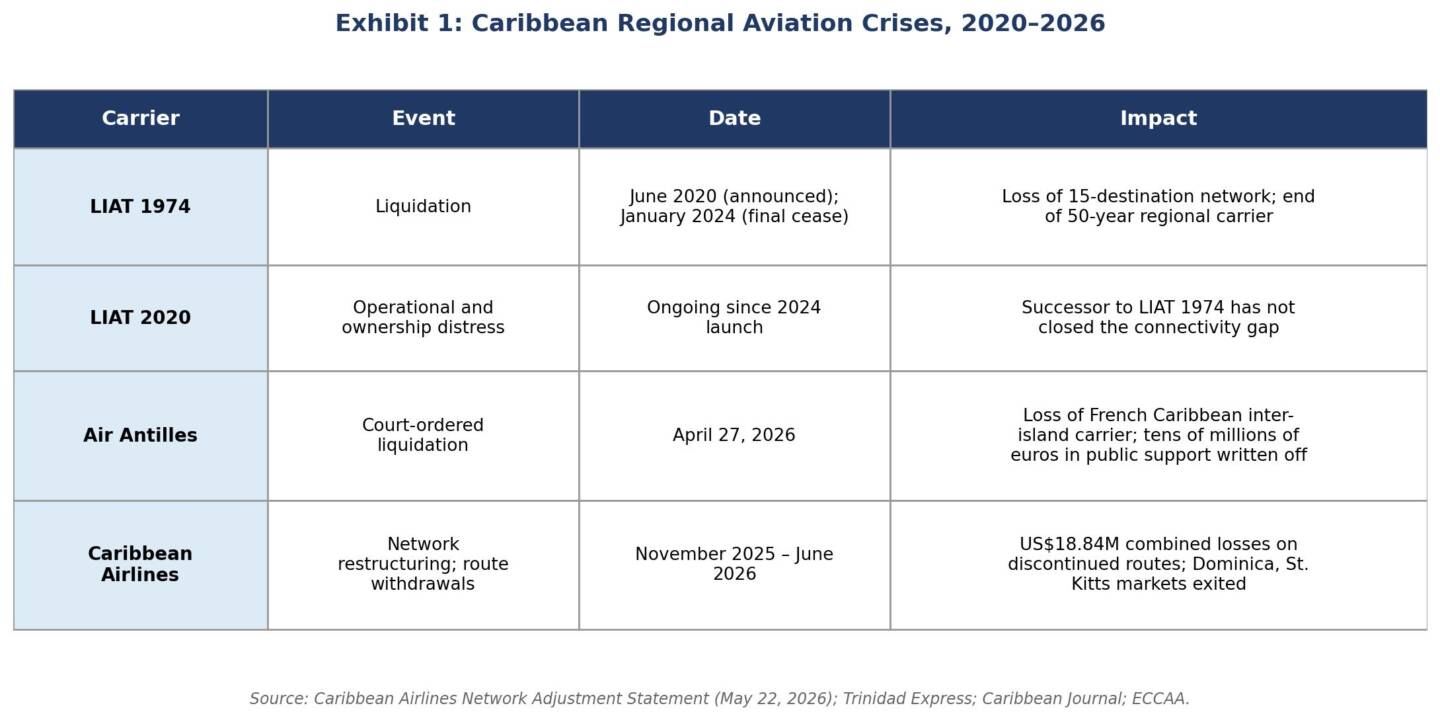 LIAT 1974 carried between 800,000 and 1,000,000 passengers annually at its peak — approximately 3,000 passengers per day across 21 destinations. By 2013, that figure had already fallen to 750,000. The pattern across the four carriers is consistent: each launched into a tougher operating environment than its predecessor faced, each accumulated losses on the routes member states most wanted served, and each was eventually forced to retreat. The structural problem has never been resolved.
Understanding the cost stack: Why regional air travel is expensive
The dominant public narrative blames the airlines. The data tells a different story. Studies by the Association of Caribbean States have found that taxes and fees average approximately 80% of the base airfare on regional routes — meaning that on a typical ticket, government-imposed costs exceed what the airline itself charges. The International Air Transport Association (IATA) has separately found that while taxes and charges average 15% of ticket cost globally, the Caribbean average is 30%, with some destinations reaching 50%. A 2016 analysis of LIAT 1974 ticket pricing concluded that taxes, fees, and charges added 54% to the cost of a one-way ticket — 40% from taxes and 14% from charges.
At Routes Americas 2025, interCaribbean Airways CEO Trevor Sadler described a customer who received a complimentary ticket from the airline but was charged US$200 in taxes — and refused to believe it. Sadler cited another route where the base fare was US$110 and the taxes were US$120. Antigua and Barbuda Prime Minister Gaston Browne has publicly noted that Antigua’s airport tax alone is US$97 per passenger, and that on a round-trip intra-regional ticket where both governments levy their full schedule of taxes, half of the total cost is government-imposed.
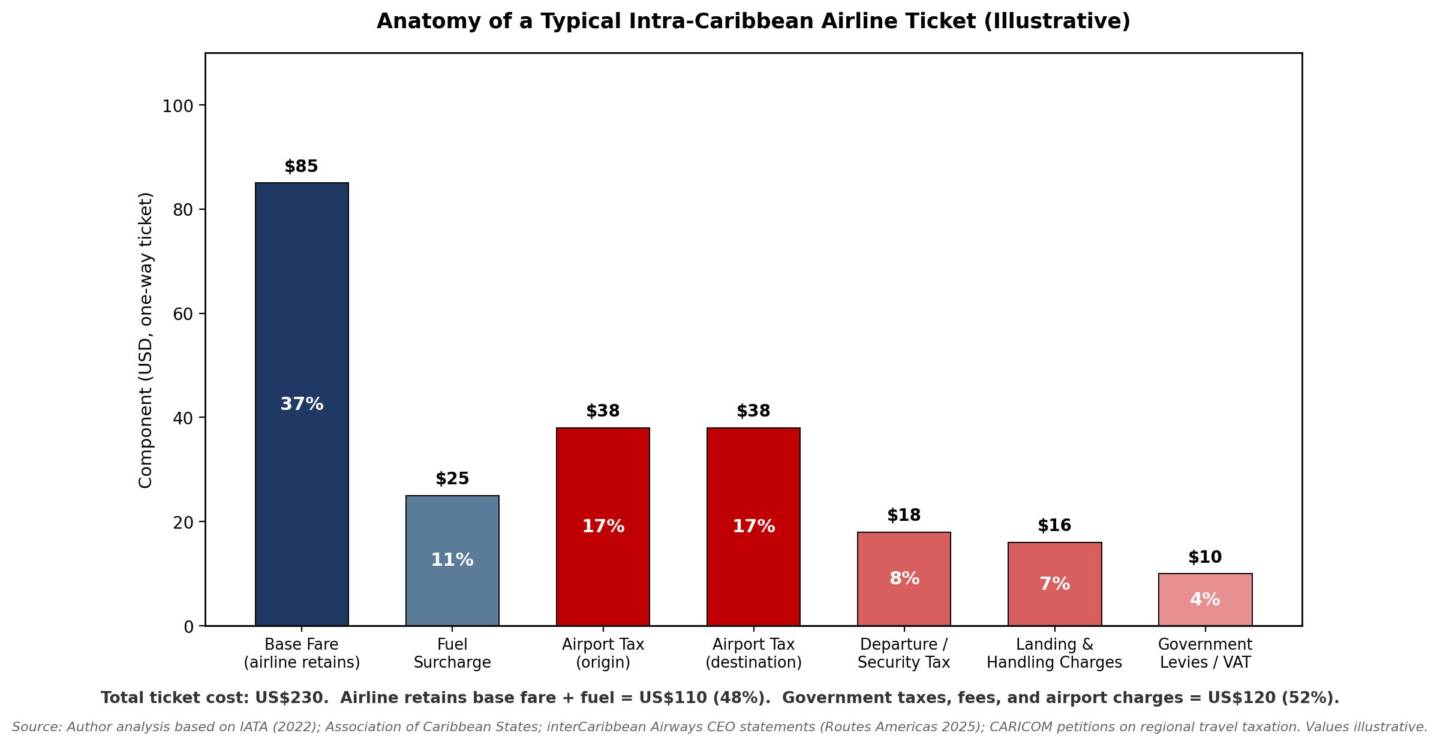 This is the binding constraint on regional aviation. Higher fuel costs since 2022, elevated insurance premiums, tightened aircraft availability, and the 2026 Strait of Hormuz disruption have all worsened the operating environment for carriers. But fuel and operational costs are not what make a Dominica-to-St Kitts ticket cost more than a Caribbean-to-Miami ticket. The decisive factor is the tax stack. Caribbean Development Bank (CDB) leadership has acknowledged the complexity directly, noting that “very often it is difficult to see the correlation between the level of costs and charges, and the actual service provided.” Member governments find themselves in a position where the same tax instruments that legitimately fund essential airport and aviation infrastructure also impose a ceiling on the volume of intra-regional travel the region can sustain. Resolving that tension — without compromising public revenues — is the policy question worth engaging.
Why this is a food security and healthcare issue
Recommendation four of the parent commentary called for a minimum 35% of food consumed in ECCU hotels, hospitals, schools, and government facilities to be sourced from regional production by 2030. That target is impossible without functional intra-regional transport — and the binding constraint here is maritime, not air. The overwhelming majority of food traded between Caribbean islands moves by sea. Caricom heads of government have themselves explicitly named regional transportation as a major obstacle to the movement of agricultural products. The regional food import bill — approximately US$17 billion annually — is what the 25 by 2025+5 framework is trying to reduce, and every credible projection of how that reduction gets achieved depends on intra-regional cargo shipping operating at a scale that does not yet exist.
The good news on this front is real. Connect Caribe — the Barbados-based private-sector ferry venture led by Pleion Group Inc. with backing from Upturn Funds Caribbean and partnership agreements with the Caribbean Private Sector Organisation, Caribbean Export, and the US Virgin Islands — has moved from announcement to active pre-launch. The project covers 3 vessels, including an 800-passenger cruise ferry, a 400-passenger fast ferry, and a dedicated cargo vessel, serving Barbados, St Vincent, Grenada, St Lucia, Trinidad, Dominica, Antigua and Barbuda, St Kitts and Nevis, Guyana, and Suriname, with a logistics hub on St Croix. Launch is now targeted for 2026 following capital fast-tracking discussions with the CDB. Caricom has established an intergovernmental working group on maritime transportation that engaged regional insurance companies in April 2025. Aviation matters in the food security equation — handling perishable fish, speciality produce, pharmaceutical inputs, and the movement of agricultural specialists — but maritime is the bulk channel, and maritime is finally moving.
The medical tourism dimension is equally critical. Recommendation 2 of the parent commentary proposed a Regional Medical Excellence Fund (RMEF) capitalised through earmarking 25% of net CBI inflows, with one tertiary speciality centre per ECCU member state — Cardiology in one, Orthopaedics in another, Oncology, Fertility, Dialysis and Renal Care, Rehabilitation Medicine, each anchored in a different island. The entire architecture rests on patients, physicians, and medical supplies being able to move between speciality centres reliably and affordably. Visiting surgeons need consistent, predictable air connectivity to commit to regional centres. International medical tourism patients flying in for a procedure in one ECCU island and onward physical therapy in another need that onward leg to exist. The ECCU’s strategic advantage in medical tourism — distributed specialisation across the union — is also its strategic vulnerability if regional connectivity fails. There is no functional RMEF without functional regional transport.
Working with ECCU and Caricom Member Governments: A constructive framework
The policy opportunity is not to replace existing subsidies with criticism, but to broaden the toolkit. Eight stimulus measures, taken together, could materially improve the economics of intra-regional travel and increase the probability that the next regional carrier — air or sea — succeeds where its predecessors struggled. Each of these proposals is offered as a constructive contribution to the conversation ECCU and Caricom member governments are already having through the CSME framework, the OECS, and the CDB:
- A Coordinated Caricom Intra-Regional Travel Tax Holiday could create an immediate stimulus. Member governments could agree, through the CSME framework, to temporarily waive or reduce departure taxes, security taxes, and airport taxes on intra-regional itineraries for a defined three-year stimulus period (2026–2028). Antigua and Barbuda demonstrated leadership in this area with its 2021 intra-regional taxation reduction. A Caricom-wide initiative building on that precedent would test the demand elasticity at modest fiscal risk, and the additional VAT and economic activity generated by increased travel volumes has been shown in multiple analyses to offset much of the foregone TFC revenue
- Harmonisation and capping of passenger facility charges across the union would address the compounding tax stack. A unified Caricom passenger facility charge — set at a defensible level in the US$25–35 range and applied once per itinerary rather than per leg — would materially reduce the tax burden on travellers while preserving airport revenue streams. The harmonisation itself can be structured to ensure no individual airport loses operating capacity
- A regional Aviation Fuel Duty Waiver for verified intra-regional flights warrants serious examination. Fuel duty is one of the most consequential cost components on short-haul regional routes. A coordinated waiver — applied only to fuel uplifted for verified intra-Caricom departures and conditioned on carriers passing the savings through to passengers — would lower carrier operating costs without affecting fuel revenues on extra-regional and tourism flights, which remain the larger share of fuel duty collections
- Reframing route subsidies as performance-based partnerships would align government spending with the connectivity outcomes member states are paying for. Where governments have historically subsidised carriers to maintain marginal routes, those subsidies could be restructured as performance-based payments tied to verified passenger volumes, on-time performance, and intra-regional cargo volumes. This converts a cost-plus relationship into a results-based partnership and gives ministers a clearer story to tell their public about value-for-money
- Establishment of a Caricom Single Air and Sea Transport Market, modelled on the Single African Air Transport Market under the African Union, would represent the most consequential structural reform available. A unified market access regime allowing qualified carriers — air and maritime — to operate any route within the union without separate bilateral approvals would reduce regulatory friction, lower the fixed costs of regional carrier operations, and increase the commercial viability of new entrants
- Designation of coordinated regional hubs — 2 aviation (VC Bird International in Antigua and Grantley Adams in Barbados) and at least 2 maritime (Bridgetown and the Connect Caribe St Croix hub) — paired with coordinated infrastructure investment and route incentives, would give the region the same hub-and-spoke economics that have made larger aviation networks viable elsewhere
- Capitalisation of a Regional Transport Infrastructure Fund through the CDB would convert the Bank’s expanded lending capacity into operational connectivity. The Euro Medium-Term Note Programme of up to US$1 billion over 3 years, alongside the CDB’s AA+ credit rating and strengthened Strategic Plan 2026–2035, provides exactly the financing architecture this kind of multi-state infrastructure program requires. The financing exists. What would accelerate deployment is a coordinated, investment-ready regional project pipeline that member governments and the CDB can develop together
- Integration of the regional transport strategy with the Bridgetown Initiative implementation framework would unlock additional climate finance for transport infrastructure. Airport hardening, port elevation in low-lying coastal facilities, and renewable energy integration at transport hubs are all eligible for the climate finance instruments Bridgetown is designed to mobilise. The connectivity strategy and the climate finance strategy are increasingly the same strategy, and the ECCU and Caricom are well-positioned to lead in demonstrating that integration
The maritime proof of concept
The maritime side of this strategy is no longer hypothetical. Connect Caribe has signed MOUs with the US Virgin Islands government, Caribbean Export, and the Caribbean Private Sector Organisation. The vessels have been identified. CDB has been engaged on capital. The Barbados Small Business Association has identified the agri-processing and small manufacturing firms ready to ship as soon as the service begins. This is what “structurally in motion” looks like — slower than promised, but real. The aviation side requires the same combination of private sector commercial leadership, regional public sector convening, and CDB financing that the maritime side has assembled.
Conclusion
Food security, medical tourism, healthcare modernisation, tourism integration, energy partnerships with Guyana, and the ECCU and Caricom alignment with the CDB and Bridgetown frameworks all share a common dependency: people and goods must be able to move reliably and affordably between member states by both air and sea. The aviation side of that dependency has come under pressure. The maritime side is finally moving — and that maritime progress is, quietly, the most encouraging development in regional integration in a generation.
Member governments have more institutional partners and more available financing in 2026 than at any point in three decades. The CDB has the financing capacity. Caricom has the convening authority. The ECCAA has the regulatory infrastructure. Connect Caribe has shown that private-sector regional transport ventures can attract serious capital and partnerships at scale. Bridgetown provides the climate finance architecture. The pieces are on the table. What ministers, finance officials, and regional institutions are now navigating is the careful work of stitching them together into a coherent, financeable programme.
This commentary is offered in that spirit. The analysis here is intended to support the work member governments are already doing, not to substitute for it. There is no single document, study, or commentary that resolves an integration challenge of this scale. There is, however, a tradition in this region of finance professionals, banking executives, regional institutions, and ministers working together to translate strategic frameworks into operational programmes. I have spent my career inside that tradition, and I welcome the opportunity to work with member governments, regional institutions, and private sector partners committed to advancing this agenda.
This is the decade of decision. How we move — by sea and by air — is one of the decisions. The good news is that it is the kind of decision the region is well-equipped to make.
About the Author
Fletcher St Jean, MBA, is a financial services executive and former Managing Director of 1st National Bank St Lucia. He previously held executive roles at Citigroup and served as President of the Bankers Association of St Lucia. He is a current participant in the Wharton Executive Leadership Program. His commentary “The ECCU’s Decade of Decision” was published recently. This piece is the second in a series. He is available to advise member governments, regional institutions, and private sector partners on the strategic and financial dimensions of regional transport, aviation, and economic integration.