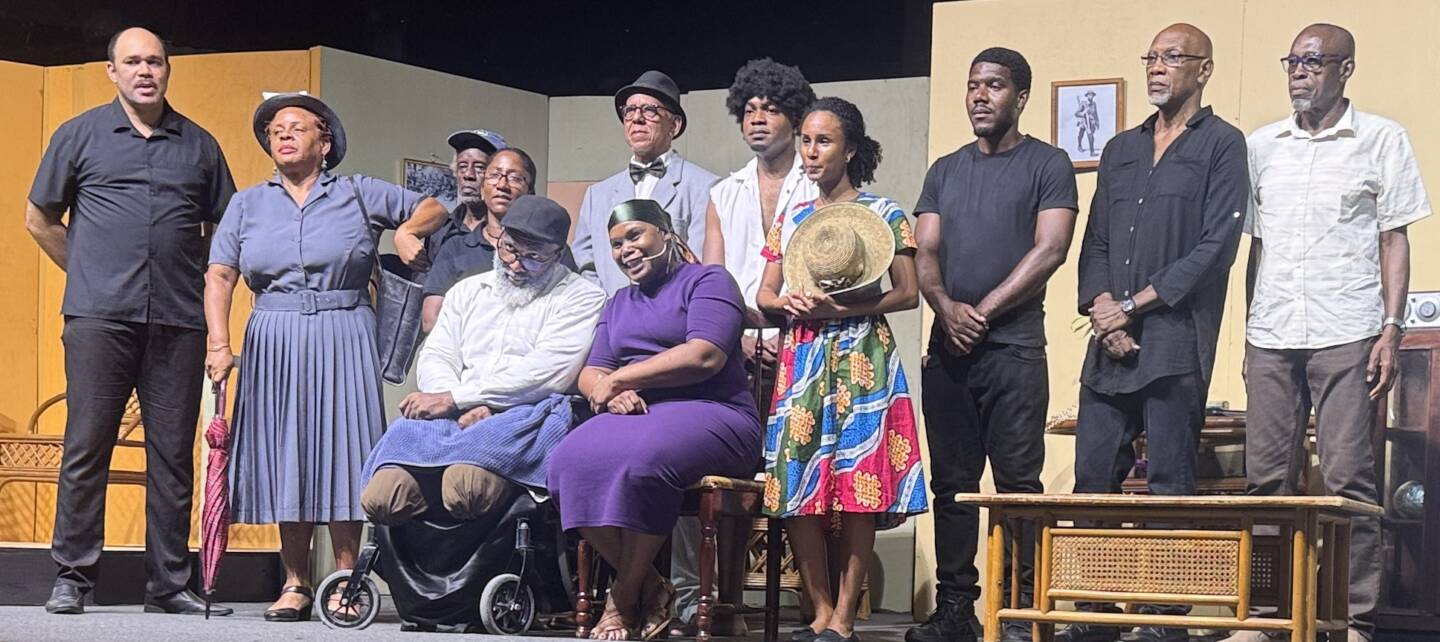















Chris DeRiggs’ Lucy’s Straw Hat is the kind of theatre that understands that history is not a collection of dates but a collection of absences.
Inspired by true events surrounding the disappearance of the vessel Island Queen, some 82 years ago, the play transforms a local historical tragedy into an intimate meditation on memory, resilience, and the fragile threads that bind a community together.
At its centre is a hat, Lucy’s hat, whose presence lingers throughout the drama like the object of the title itself: a simple straw hat that becomes a powerful symbol of loss, identity, and remembrance. DeRiggs wisely avoids sentimentality, allowing the story to emerge through the voices of those left behind rather than through grand historical exposition.
Among the strongest performances is that of Neila Ettienne, who brings emotional gravity and authenticity to the role of Agatha DeSilva. Her powerful performance anchors the production, giving the audience a human point of entry into the larger historical narrative. She understands the power of restraint, allowing silence and gesture to carry as much meaning as dialogue.
DeLeon Walters provides an effective counterbalance, bringing energy and dramatic tension to the ensemble. Portraying Pa John, Walters’ performance captures the uncertainty and frustration that often accompany communal tragedy, creating moments that feel both personal and universally recognisable.
The appearance of Rene DeRiggs as Hyacinth DeSilva adds another layer to the production. There is a natural ease in the performance that strengthens the familial and communal dynamics at the heart of the play. Rather than competing for attention, DeRiggs contributes to the ensemble’s collective storytelling, a quality that distinguishes strong community theatre from mere spectacle.
Particularly memorable is the character of Lucy DeSilva played by Rose Bhagwan, portrayed with warmth, humor, and humanity. Bhagwan functions as more than comic relief; the character becomes a vessel through which the audience experiences the rhythms of everyday Grenadian life. In a play dealing with grief and uncertainty, these moments of levity are essential, reminding us what is at stake when lives are disrupted by tragedy.
In the clever role of narrator/reporter, Samuel Ogilvie takes on a new persona. His English accent is nearly impeccable, and his understated tone distinguishes this character from those forceful and loud roles he has previously played. Samuel has broadened his repertoire.
W E Julien, depicted by Dexter Yawching, may have seemed like a minor role, but in the telling of Grenada’s history, his contribution was significant. So too the appearance of the Matron in the person of Deborah Grey. She continuously brought us back to the present in the telling of the tale.
As writer and director, Chris DeRiggs demonstrates a keen understanding of oral storytelling traditions. The production feels rooted in Grenadian speech, memory, and cultural experience. The pacing occasionally lingers in scenes that could be tightened, but the emotional honesty of the work more than compensates. What emerges is a theatrical experience that feels genuinely local while speaking to universal themes of loss, endurance, and collective memory.
The greatest achievement of Lucy’s Straw Hat is that it refuses to let history remain abstract. By focusing on individuals and families rather than historical events alone, DeRiggs creates a work that resonates long after the final curtain. The audience leaves not simply remembering a story, but carrying the weight of those who have been lost and the communities that continue to remember them.
The fourth wall is somewhat drawn back when Agatha turns directly to the audience, pleading for mounting a plaque with the names of the 67 people who disappeared forever. It’s not too late.
In an era when Caribbean stories are too often reduced to postcard imagery, Lucy’s Straw Hat stands as a reminder that the region’s most powerful narratives are found in its lived histories, its ordinary people, and its determination to remember. It is a moving and culturally significant contribution to Grenadian theatre.
Art House 473