







by Curlan Campbell
- Grenadians marched through capital in solidarity with President Ibrahim Traoré of Burkina Faso
- Traoré praised for bold steps to reclaim Burkina Faso’s independence from Western dominance
- Participants reflected on significance of African Liberation Day and current wave of resistance sweeping across African continent
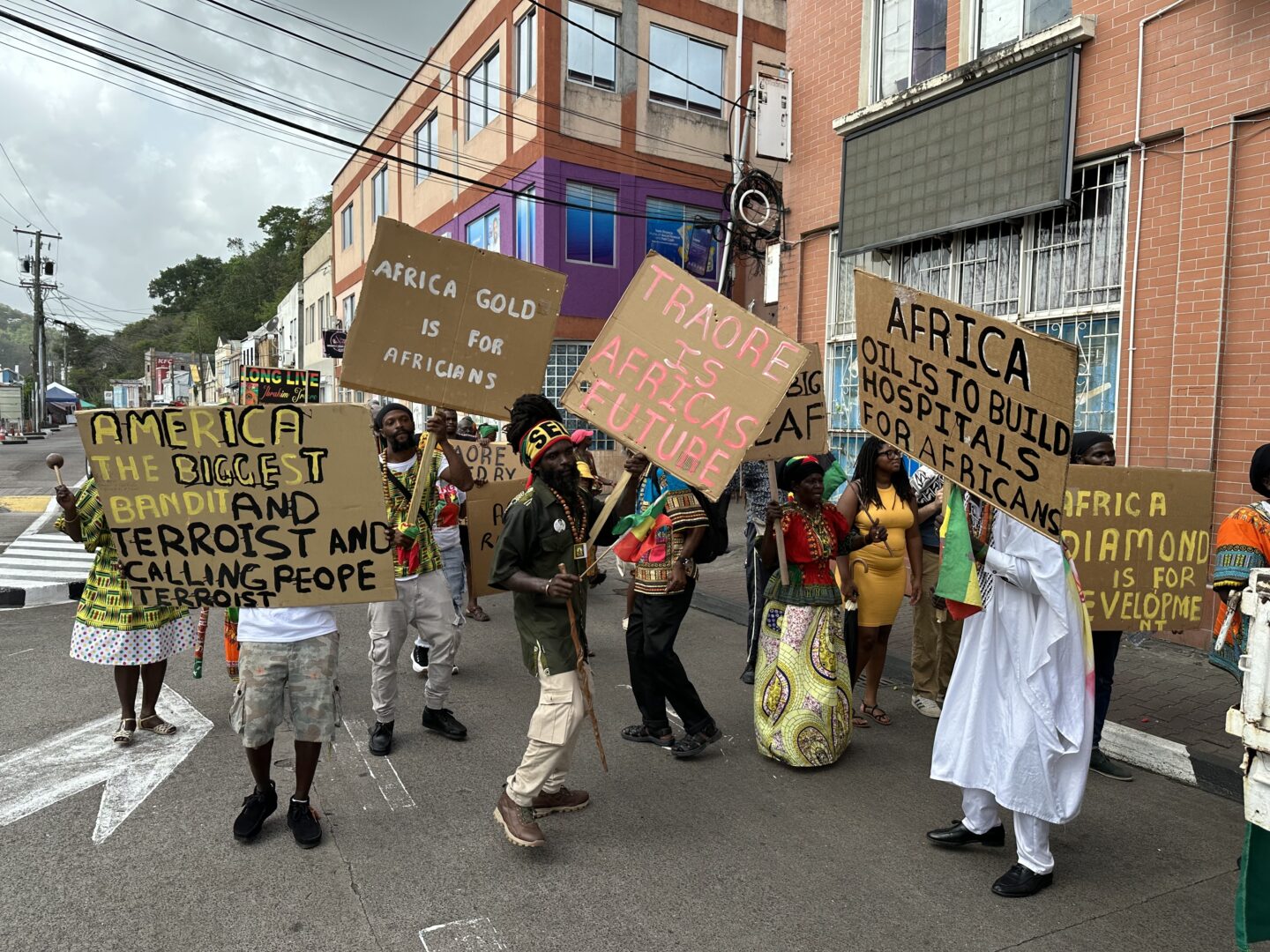
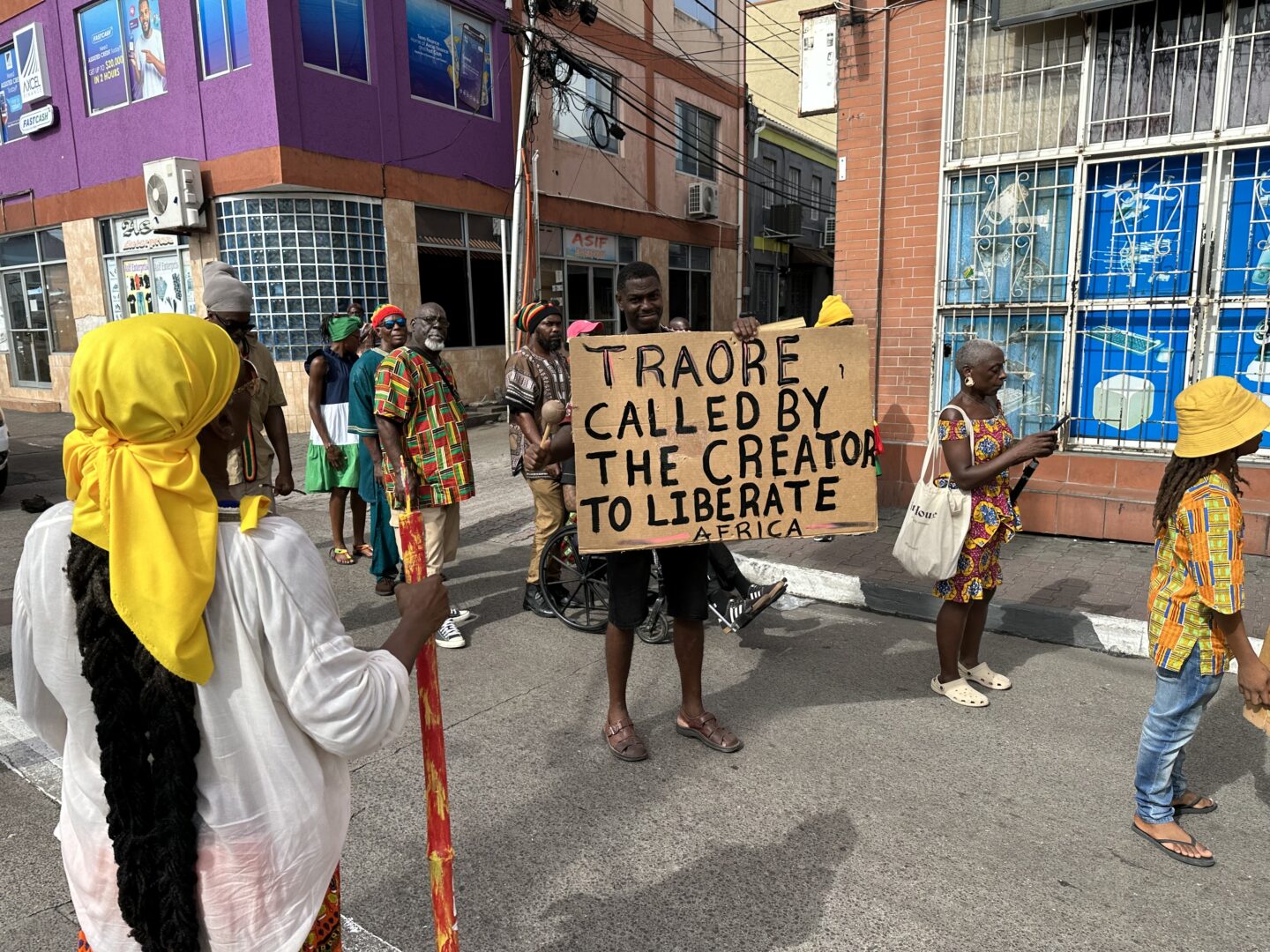
Placards stating “Traoré called by the Creator to liberate Africa” and “America: the biggest bandit and terrorist—calling others terrorists” went beyond mere cardboard signs. They represented declarations of reclamation, resistance, and rebirth.
On African Liberation Day, Grenadians led by the Rastafarian Organisation for Centralisation (ROC), took to the streets of the capital to march, holding placards that conveyed bold messages against neocolonialism, foreign exploitation, and Western imperialism.
The message was clear: they expressed strong solidarity with President Ibrahim Traoré of Burkina Faso, denouncing foreign interference in African sovereignty and demanding justice from European colonial powers. The slogans, chanted and displayed with conviction, not only referenced the historic struggles of African nations but also highlighted the rising popularity of Traoré, a revolutionary leader who has become a symbol of Africa’s modern resistance against exploitation and foreign domination.
The procession guided by Nyabinghi Drummers progressed through the heart of St George’s, culminating in a formal ceremony in front of the Esplanade Mall on Sunday, 25 May 2025. There, cultural leaders, government officials, and members of the diaspora gathered to reflect on the significance of African Liberation Day and the current wave of resistance sweeping across the African continent.
Speaking on the occasion of African Liberation Day, Ras Ruan, a representative of the ROC, issued a stirring call for unity, centralisation, and resistance against forces of division. Drawing inspiration from His Imperial Majesty Haile Selassie I’s 1966 visit to Jamaica, Ras Ruan echoed the emperor’s call to “organise and centralise” as a powerful antidote to disunity. “The enemy is aware that disunity is a significant weakness,” he declared. “But change begins when all our brilliant minds come together, focusing in one direction to overcome every obstacle. This is what the enemy fears: our united energy.”
Despite rainy weather during the celebrations, Ras Ruan likened the rain to a blessing, expressing confidence that it symbolised renewal and hope. “After the rain, sunshine will follow,” he said.
The ROC Representative reaffirmed his commitment to the principles of African Liberation, praising those on the frontlines of resistance across the African diaspora. “I give thanks for African Liberation Day and for the valiant warriors on the battlefield who never falter,” he said. “Here in Grenada, it was once celebrated as a holiday; African Liberation Day represents the revolution.”
He also warned against ongoing efforts to destabilise Grenada and the broader Pan-African movement, emphasising that the struggle for unity, sovereignty, and dignity continues despite political pressures. “Despite the struggles, such as attempts to undermine our paradise and unity, I remain committed to keeping the fire of resistance burning,” he affirmed. “The world can see the truth in our situation, and it becomes more evident as we confront the political landscape.”
Mother Mutaru also made a clarion call for the unification of all Rastafarians throughout Grenada, drawing inspiration from their recent trip to fellowship with the Rastafarians in Antigua. “All the Rastafarians work together. They walk as one. They unite as one and form a unified economic front. We need to take a lesson from them and strive for the same, bringing every Rasta in this land together in unity. Together, we can achieve strength that no division can break. We must reject individuality and separation. Unity is our oneness.”
During this year’s African Liberation Day commemorations, representative of the Grenada National Reparations Committee Rochel Charles praised Traoré for his bold steps to reclaim Burkina Faso’s independence from Western economic dominance. These include the nationalisation of 2 gold mines, halting the export of unrefined gold to Europe, and investing heavily in agriculture and infrastructure, including the construction of a new international airport. His policies were described as vital to “freeing his country from dependence on former colonial powers.”
“President Traoré has survived 19 assassination attempts, most if not all orchestrated by forces outside Burkina Faso, yet he continues forward. The world is watching, and we stand firm with him,” Charles declared.
The committee condemned what it called a “relentless Western propaganda campaign” designed to destabilise and reverse Burkina Faso’s development trajectory. It reaffirmed its demand for reparative justice for Africa and the Caribbean, stressing that colonisation, slavery, and genocide had left enduring wounds that must be repaired.
Charles recalled a long and brutal history of European exploitation, citing events as far back as 1444, when Portuguese sailors began kidnapping Africans. The address condemned the role of figures such as Pope Nicholas V, Queen Elizabeth I, and Holy Roman Emperor Charles V in institutionalising the transatlantic slave trade. “We were dehumanised; treated worse than animals,” Charles said. “Tossed overboard like cargo, with insurance ready to pay for our deaths. That was the system created to enrich Europe at the expense of Africa.”
The committee reminded former colonial powers — Britain, France, Spain, Portugal, and the Netherlands — of their moral and legal obligation to repair the damage they caused. Citing the Caricom 10-Point Action Plan for Reparatory Justice, the speaker called for repatriation, debt cancellation, and economic development programmes as part of the redress.
The address was also a celebration of Pan-African unity, praising Maurice Bishop, Marcus Garvey, Martin Luther King Jr., Malcolm X, and Haile Selassie. It recognised modern leaders like Traoré and other African heads of state, who were pursuing sovereignty and regional solidarity through the Organisation of African Unity (OAU).