










by Curlan Campbell
- Article 6 encourages countries to collaborate in reducing their carbon emissions
- Conference will discuss progress on reducing greenhouse gas emissions
- COP29 runs from Monday, 11 to Friday, 22 November
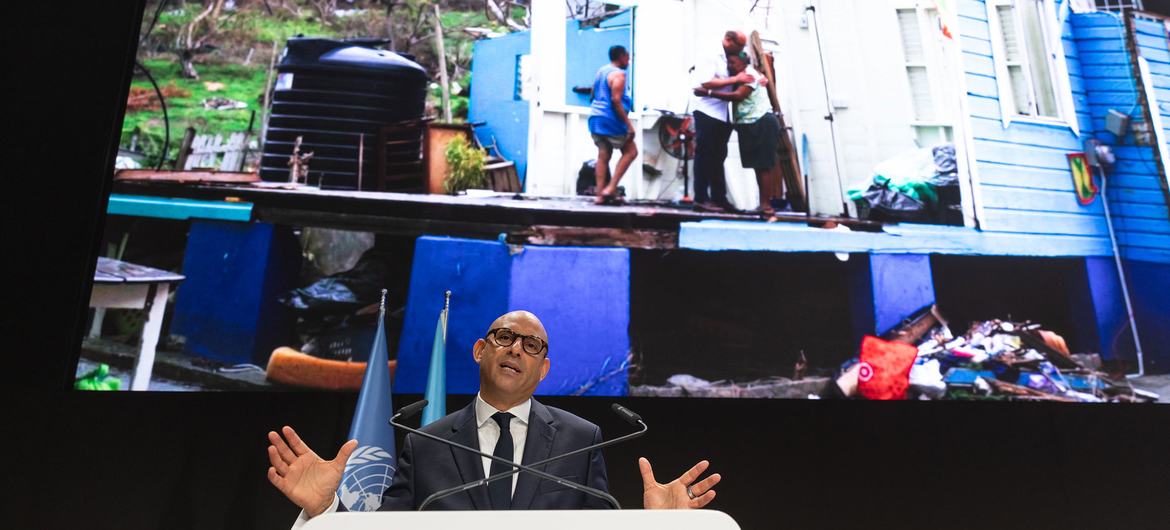
While addressing delegates from nearly 200 countries to mark the start of another round of negotiations in Baku, Azerbaijan, Simon Stiell, Executive Secretary of the United Nations Framework Convention on Climate Change (UNFCCC), was emotional as he reflected on the devastation caused by Hurricane Beryl.
Stiell, who is from Carriacou, shared heartfelt images of his neighbour, Florence Snagg who resides in Hillsborough, among the ruins of her home. In one of the photos, Stiell is seen embracing the 85-year-old woman, expressing his sympathy for her suffering.
This year’s United Nations Climate Change Conference, the 29th Conference of Parties known as COP29, will discuss progress on reducing greenhouse gas emissions, with each country setting its own targets and action plans to help limit global warming.
Recovering after a brief moment of tears, Stiell with heartfelt conviction, urged that this COP29 must not end without agreeing on a new global climate finance goal. “The UNFCCC process is our only forum for tackling the ongoing climate crisis and for holding one another accountable to take action,” he stated. ”This process is effective; without it, humanity would be on a path toward five degrees of global warming.”
One of the major highlights of his message attempted to dispel the notion that climate finance is charity.
“If at least two-thirds of the world’s nations cannot afford to cut emissions quickly, then every nation pays a brutal price. If nations can’t build resilience into supply chains, the entire global economy will be brought to its knees. No country is immune. So let’s dispense with the idea that climate finance is charity,” Stiell said. He emphasised that an ambitious new climate finance goal is essential for every nation, including the wealthiest and largest ones. However, he noted that agreeing on a goal is not sufficient; it is also necessary to “work harder to reform the global financial system, providing countries with the fiscal space they urgently need.”
Stiell also clamoured for Article 6 of the Paris Agreement to be finalised and implemented. “We must get international carbon markets up and running by finalising Article 6; we need to move on mitigation so targets from Dubai are realised,” he said. Article 6 encourages countries to collaborate in reducing their carbon emissions. It provides 2 options for countries and companies to trade carbon offsets, which can assist them in achieving the targets they have established for lowering greenhouse gas emissions in their climate action plans, referred to as nationally determined contributions (NDCs).
Carbon credit trading also known as carbon emissions trading, is a centralised, market-based system that allows for the buying and selling of carbon credits to help reduce greenhouse gas emissions. The proposed system was negotiated during the COP26 climate summit in Glasgow, Scotland.
Stiell made a case for clean energy and infrastructure investment. “We mustn’t let 1.5 slip out of reach, and even as temperatures rise, the implementation of our agreements must claw them back. Clean energy and infrastructure investment will reach $2 trillion in 2024 almost twice that of fossil fuels. The shift to clean energy and climate resilience will not be stopped. Our job is to accelerate this and make sure its huge benefits are shared by all countries and all people,” he said.
He stated that the biannual transparency reports due this year will provide a clearer picture of the progress made and the gaps to address.
This year, all countries will present the third generation of their national climate action plans to support the creation and communication of these plans. The UNFCCC will launch a climate plan campaign aimed at mobilising action from all stakeholders, aligning with the efforts of the UN Secretary-General and the incoming Brazilian COP presidency.
Stiell declared that the UNFCCC will restart climate weeks in 2025, aligning them more closely with our processes and the necessary outcomes they aim to achieve.
COP29 will focus on establishing a new annual climate financing target to replace the $100 billion pledge made in 2009. This pledge will expire at the end of the year, and many believe it is insufficient to address the rapidly rising air and sea temperatures. The conference started on Monday, 11 November and will conclude on Friday, 22 November.