






by John Angus Martin
A tribute to the people of Carriacou and Petite Martinique, who experienced complete devastation at the hands of Hurricane Beryl on 1 July 2024.
“I’ve seen movies, I’ve heard about hurricanes but never in my wildest dreams I would have lived to experience what I’ve experienced with Hurricane Ivan, looking and seeing for myself houses and rooftops literally lifted and blown away. It was unbelievable!” Michael Bascombe, BBC Caribbean Correspondent (8 September 2004)
“We will have to go back to the land and plant up. It’s the land you understand. That’s where the food must come from. Back to square one, man.” Alfred Morian, nutmeg farmer (New York Times 9/2004)
“The devastation caused by Ivan was almost total, and as I’ve indicated to people, the devastation is even worse from a psychological standpoint.” Dr Keith Mitchell, Grenadian prime minister (New York Times 9/2004)
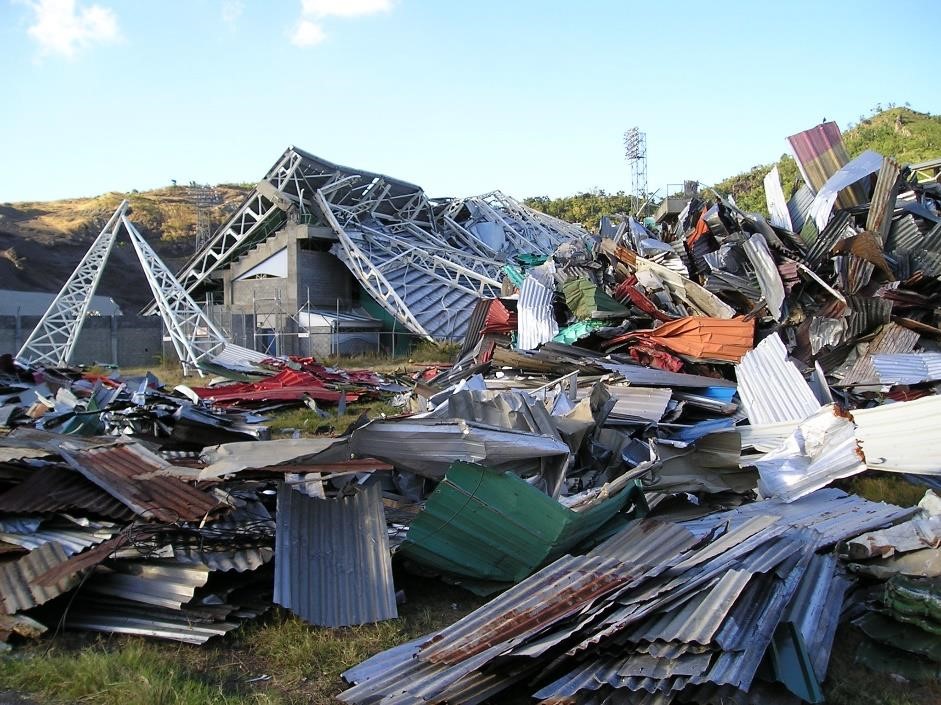
On the morning of Wednesday, 8 September 2004 shell-shocked Grenadians awoke in awe of the damage and destruction wrought by Hurricane Ivan, a category 3 storm that laid waste to their island home the day before (OECS 2004; Khalid and Babb 2008; Peters 2017). It was one of the most powerful hurricanes to hit the Caribbean in a decade, and Grenada in 5 decades (after Hurricane Janet devastated the island on 22-23 September 1955). There was death and destruction everywhere as Grenadians stared wide-eyed at the dramatically altered landscape laid bare before them from only a day before. Their tropical island home went from lush green to brown, barren and battered in less than 6 intense hours, with debris strewn everywhere, conjuring a fictional “post-apocalyptic” landscape.
Landscape changes are driven by multiple forces, both natural and cultural, which together interact to produce landscapes as we observe them. Changes to the landscape usually happen over long periods and are gradual, but some can be abrupt, as in the case of an earthquake, volcanic eruption, flood, fire, pandemic, technological change, or hurricane, which can totally alter a landscape in a very short space of time and have far-reaching consequences (Cooper 2012; Entrikin 2011; Richardson 1997). A
sudden change to the landscape provides a unique opportunity for observation and study. It can reveal hidden elements and allow insights into changes that created the landscape in the past or that can affect it in the future. It can expose the past in a way that can explain aspects of the present, or even the future. It can transform the present and past, destroying the representations and memories that have influenced identity, thus changing the value placed on them (Butler et al. 2019). It can make some question their sense of belonging or connection to a place as a result of loss, while it can make others feel a greater sense of place by exposing hidden memories or a desire to rebuild and recreate a heritage (Butler et al. 2019; Tilley 2006). A natural hazard presents a living experiment of sorts, and Hurricane Ivan in Grenada on 7 September 2004 was one such experience (Collins 2007; OECS 2004; Khalid and Babb 2008; Watts 2011).
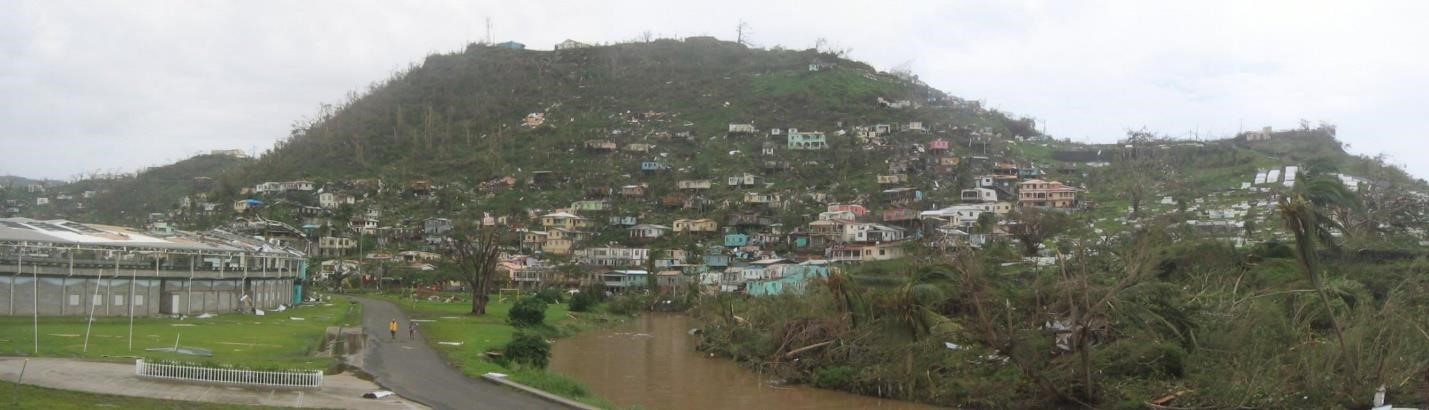
The images of Grenada that emerged after the passage of Hurricane Ivan revealed a landscape — physical, social and economic — that was hitherto unknown and unreal to most Grenadians, except maybe for those who had experienced Hurricane Janet as a child or young adult almost 5 decades ago (McIntosh 1956); maybe the experience of the US invasion in 1983 is a close analogy as well. The pictures presented a ghostly image as if the island had been pushed or rather squeezed through an X-ray machine, exposing a crumpled and blurred silhouette barely discernible in the intense clarity of the light of day following the hurricane. If only in its irony, it was awe-inspiring how such a fear-inducing and destructive power could create such a devastatingly “beautiful” landscape.
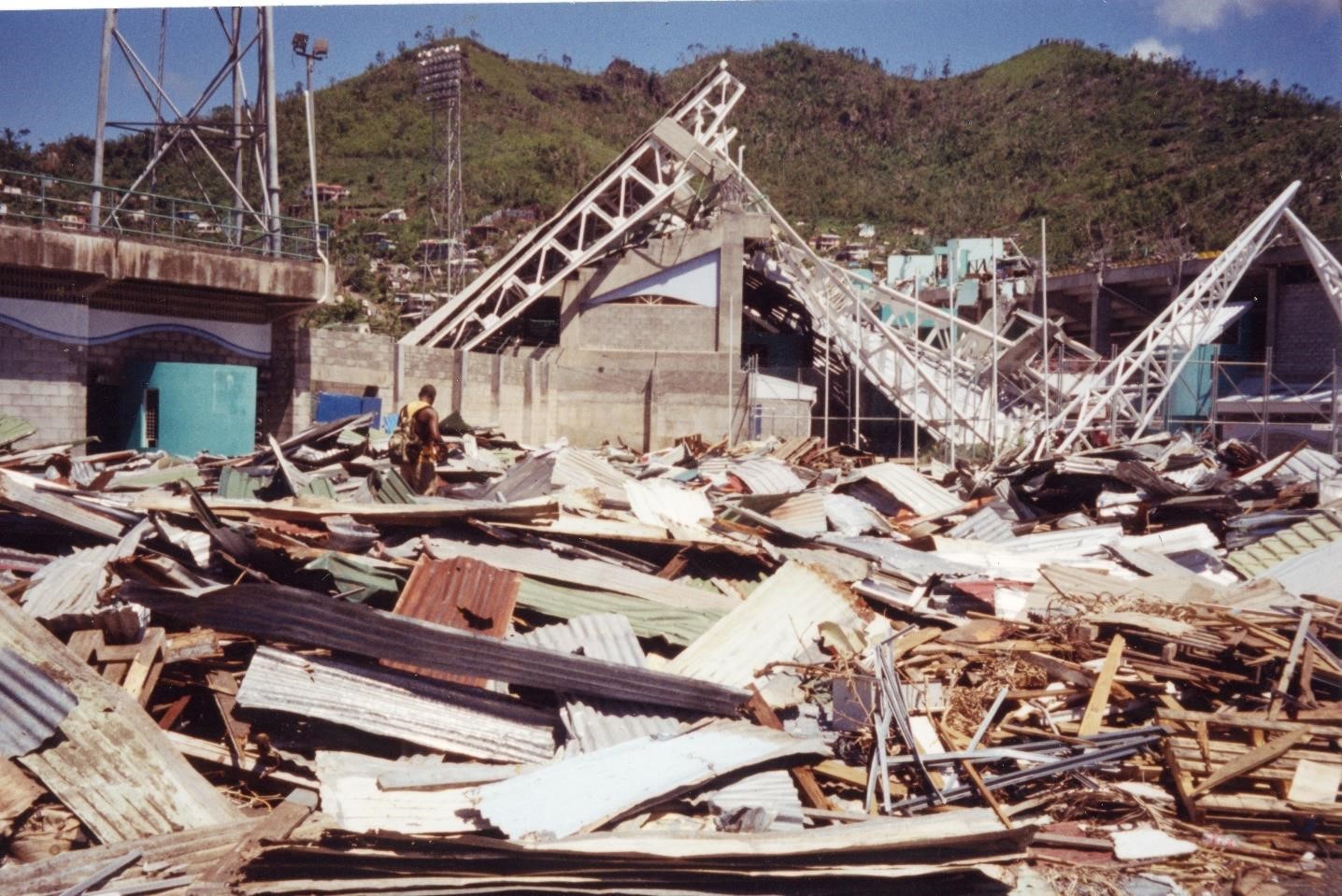
Hurricane Ivan proved a bit unusual in that it was not a wet storm though there was rain everywhere, but not as much to cause extensive flooding and dangerous landslides (Allen et al. 2017); but it had lots of wind, with sustained winds of 185 kph (115 mph) and gusts of over 233 kph (145 mph). It was the wind that caused extensive damage to the roofs of buildings, blowing the red, green and yellow-painted sheets of galvanise iron everywhere, recalling Paul Keens Douglas’ (1976) dramatic rendering of Hurricane Janet in “Storm Comin’.”
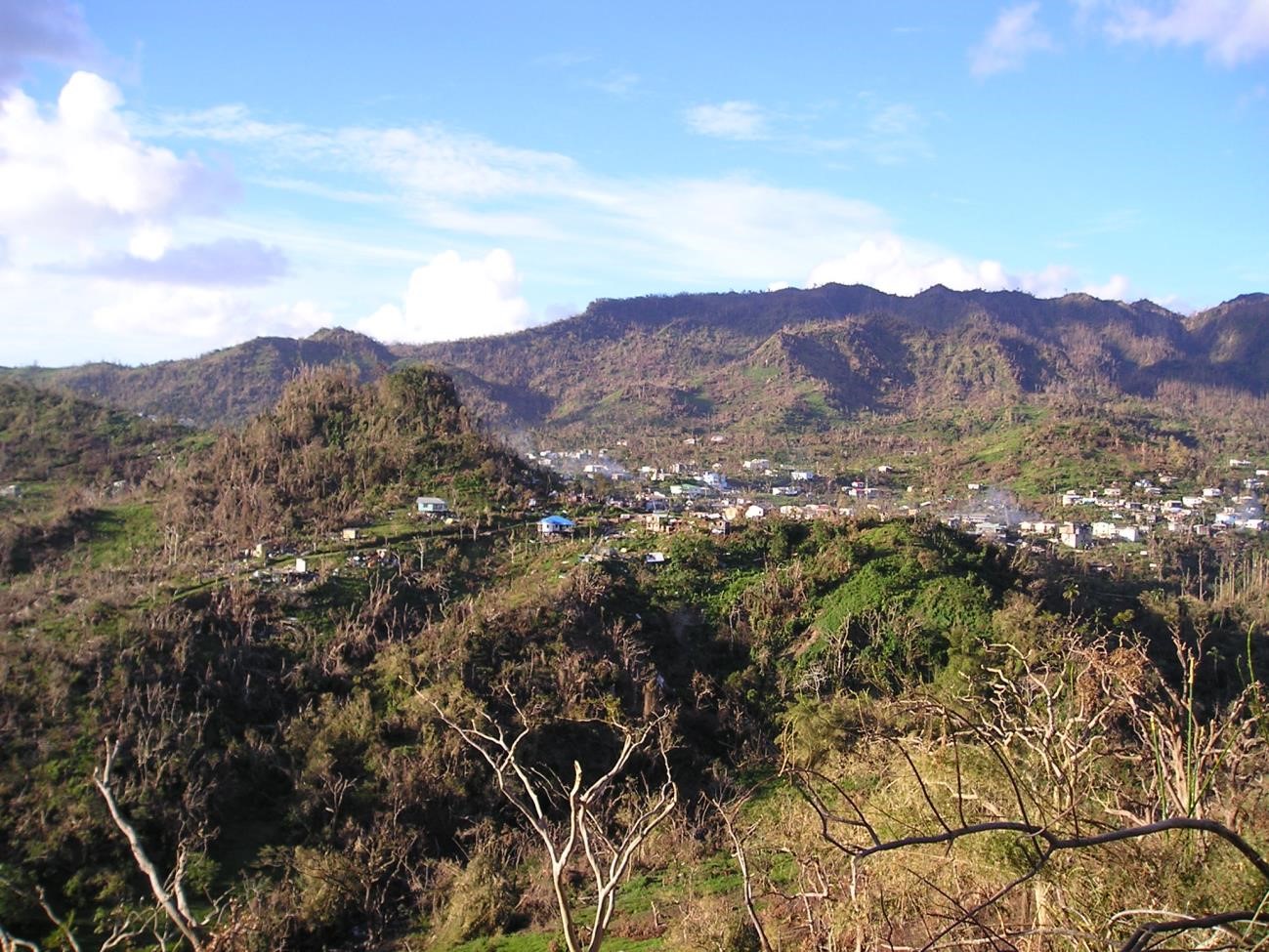
The severe winds had removed practically all the leaves from the bushes and trees, leaving denuded stumps and branches and allowing expansive views once obscured by a verdant landscape. People were impressed by the panoramic views that stretched across once hidden landscapes, reveling in the fact that they could now see clearly across the island from some vantage points.
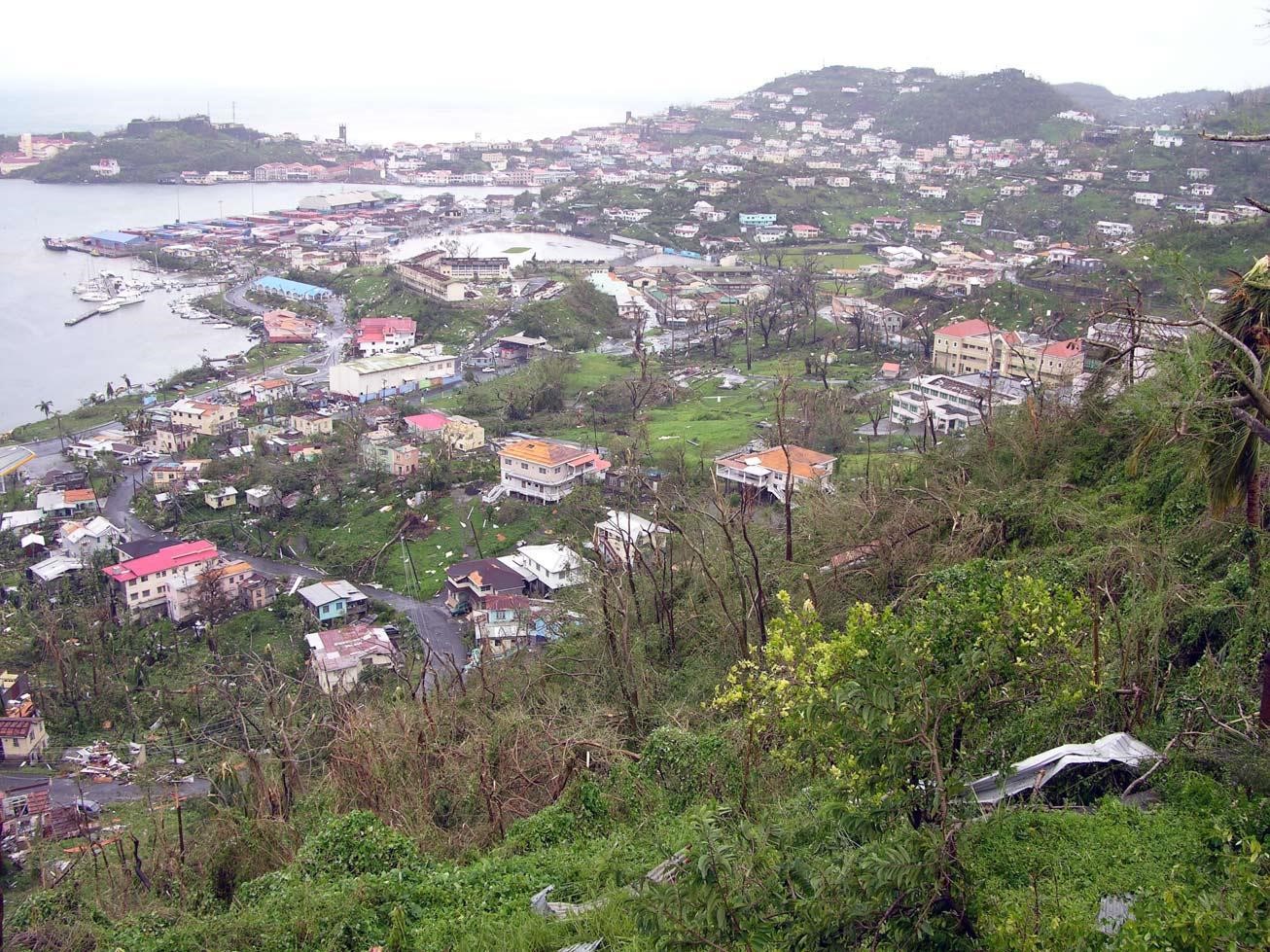
Writer Merle Collins (2007:14) captures the feeling in Tout Moun ka Pléwé (Everyone Bawling): “I looking up at Mount Gozo and I watching all the belly turn inside out. I turn ’round and I seeing down into Westerhall like it right next door. I watching car turn corner a mile away. I watching St Paul’s and over by Mills on the hill. I looking around and realising I have plenty neighbours, and people not far away from each other at all, down here in what used to be Morne Delice Cocoa.”
It was an eye-opening experience as years of hidden landscapes, of obscured views, and of shrouded memories came into full panoramic view.
One of the starkest views was of the denuded evergreens that remained rooted in the face of the severe winds but were unable to hold on to their leaves and even branches. Almost 50% of canopy trees in the Grand Étang Forest Reserve, Grenada’s primary forests, had been uprooted, leaving behind a broken forest of mangled trunks and branches (World Bank 2005). The broken trees unearthed roots that had been deep into the soil for at least two generations, having recovered from the last severe hurricane that had itself altered the arboreal makeup of these forests (Glenn and Bensen 2008). Large trees lay broken across the leaf-covered hills and valleys, as the sight of hundreds of acres of leafless trees, ghosts in the landscape, proved almost unimaginable to many who had only known the lushly covered mountains.
It was like a fire had laid waste the mountainscape. It left Collins (2007:16) thinking, “Hmmm; Ivan leave message on leaf for everybody to read.”
The seascape was not spared as a storm surge, rising to over 3 metres (9.8 feet) in some areas, destroyed homes, fishing boats, beaches (by removing sand), coral reefs and wetlands, battering the already vulnerable coastlines as majestic coconut trees laid broken in the surf. Underwater was not spared as coral reefs were further damaged by the rough seas, adding to the coral bleaching that had already destroyed some of the reefs. Some fishing communities were severely affected, like Marquis and Soubise, St Andrew on the eastern coast where small wooden boats and houses of the fishing communities were literally transported onto the landward side of the road by the intense winds some almost intact, allowing the owners to return them to their original places with minimal repairs later on (OECS 2004).
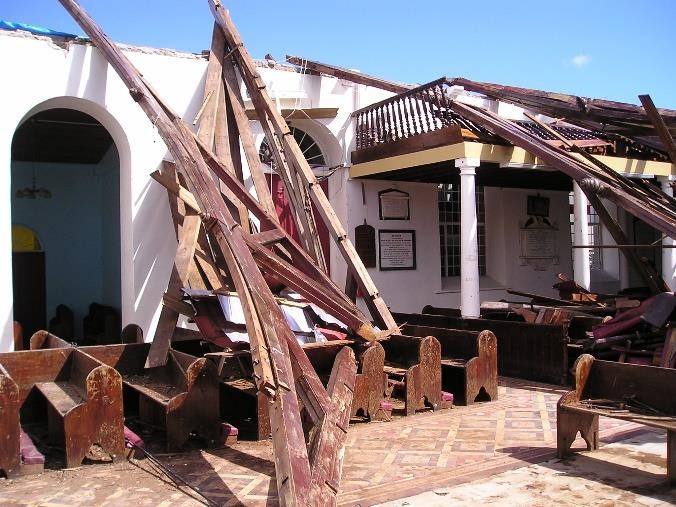
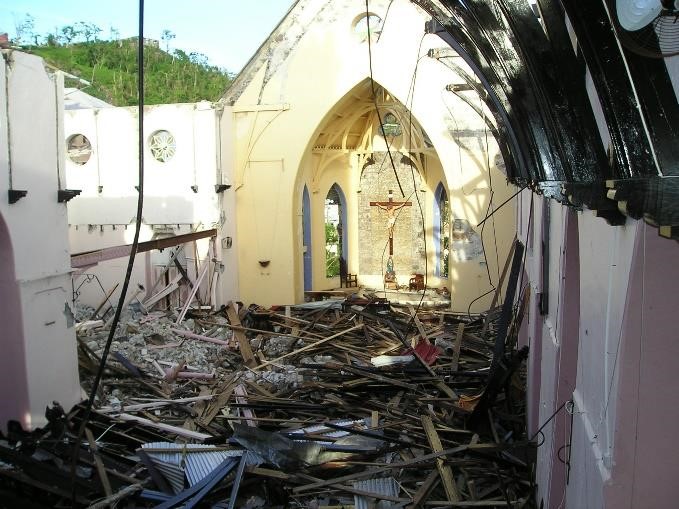
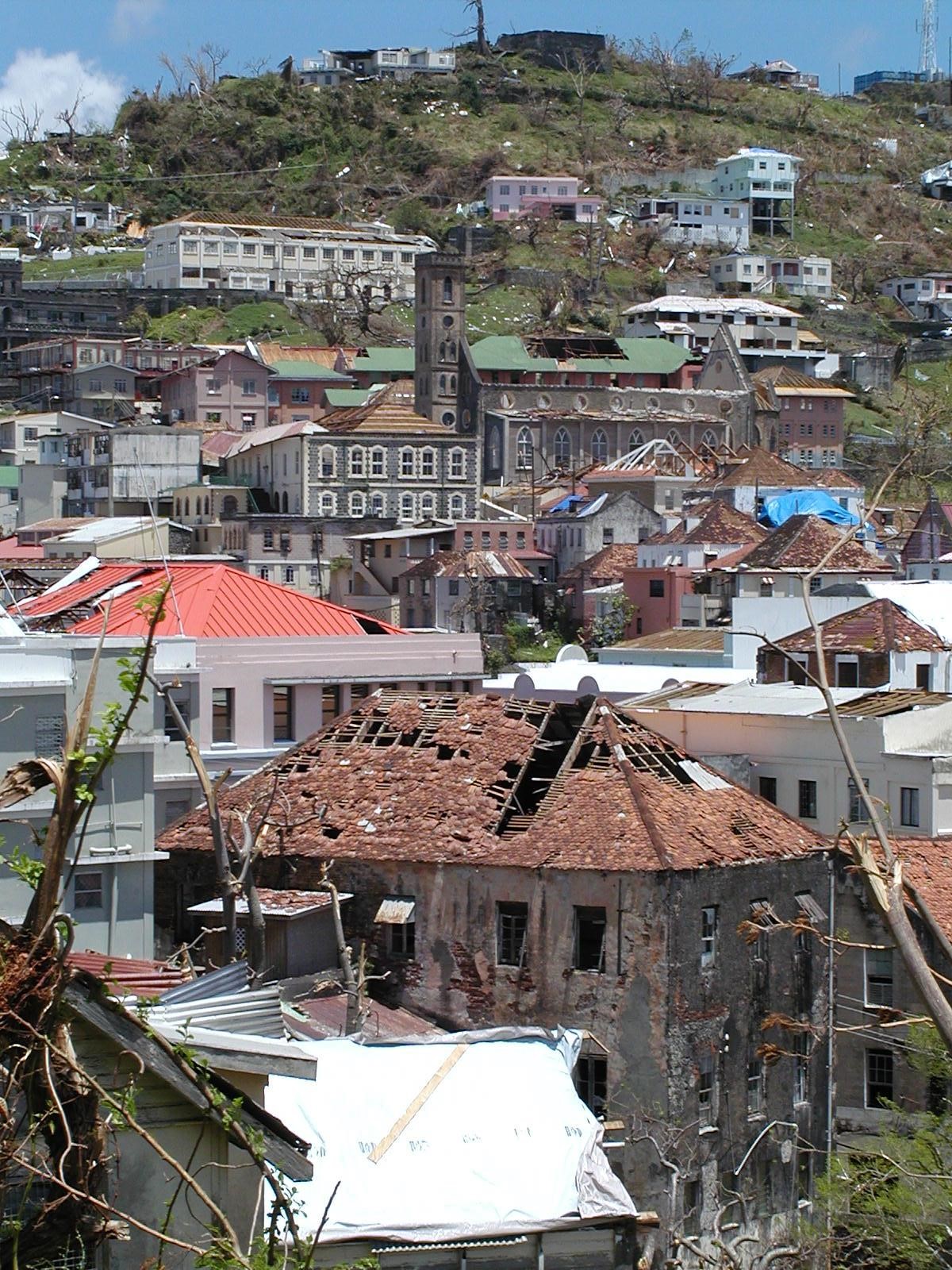
The Town of St George, Grenada’s historic capital with its 18th-century Georgian-era buildings, was rendered almost roofless, as centuries-old broken slate bled the streets red, and bricks brought as ships’ ballast centuries ago crumbled under the weight of their own laboured history (St George’s, Grenada: Caribbean Monument 1988; Holmes 2006; Holmes and Jessamy 2006). Over 100-year-old churches, whose longevity had been taken for granted by those who passed by them daily, crumbled under the weight of their beliefs, though some jokingly or mockingly blamed a higher power. The over 200-year-old Parliament building at York House that sanctioned Grenada’s violent history through slavery, rebellion, emancipation, colonialism, civil unrest, independence, revolution, and US invasion, saw its roof take wings, exposing the vulnerability (and some might add hollowness) of its democracy and judiciary housed within (Holmes 2006).
Government House, that enduring symbol of colonial authority and dominance since the 1780s (but home of the governors-general after Independence), laid broken and exposed as if signalling an end to the islands’ continued deference to its burdened colonial past and the anachronistic position it enthroned. Some abandoned historic buildings finally succumbed to the tempest, tired of being neglected despite all the talk (by politicians) of preserving heritage. Power and communication lines and poles laid broken and dishevelled, creating a tangled web of debris just like the government’s immediate response to the disaster. Broken trees and branches clogged up rivers and streams or were pushed downstream with such force that they brought with them broken pieces of bridges and debris as they disgorged into the sea, echoing the old expression “the river come down.”
The storm unleashed a fear that had not been felt in recent memory as people witnessed the unfamiliar unfold before their eyes. As many as 90% of buildings were damaged, with some 30% (14,000 homes) destroyed, leaving 18,000 people homeless, shirtless, waterless and foodless (OECS 2004). Thirty-nine people died due to Hurricane Ivan, and many more would die immediately following as the stress and burden of the disaster overwhelmed and consumed them. So dreadful was the situation that some understandably quenched their thirst and hunger by breaking into stores and looting, but others just quenched felonious desires and broke into homes to seek what valuables they could recover for themselves (Wilson 2004). It was a place that many would not have imagined themselves before, or ever.
When the tally was done, it was estimated that the damages to the island amounted to some US$815 million (200% of the island’s GDP), the majority due to damages to infrastructure (OECS 2004; World Bank 2005). Affected most profoundly were Grenada’s agricultural and tourism industries upon which the island’s mono-crop economy uncomfortably rested, propped up like an old “board house” on stilts by the former and the latter covetously eyed as a panacea should the former collapse. About 60% of the island’s nutmeg trees, Grenada’s “black gold,” were destroyed, while crops like banana suffered 100% destruction; it would be the banana’s last hurrah as an export crop (World Bank 2005).
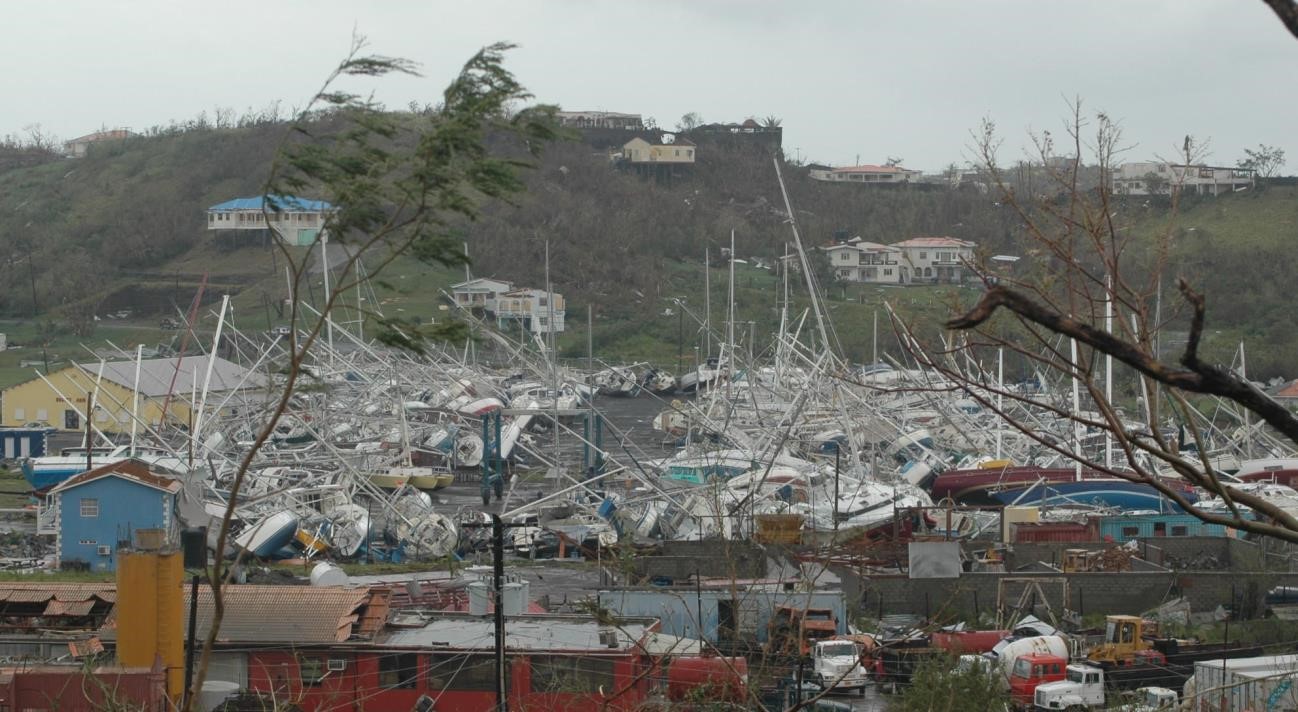
Grenada was in danger of losing its “Isle of Spice” identity with large numbers of its spice trees blown away and taking with them the sweet-smelling fragrant air that visitors often imagine. Many hotels were damaged and the destruction to the islands’ infrastructure meant that the upcoming tourism season two months away would not be able to save the island this time; it would suffer at least a 10% decrease in revenues in the first year alone (Economist 2017). In recent years, Grenada had become a mecca for yachts to ride out the hurricane season because insurance companies had considered it safe, but the storm ignored the imagined boundary and caused extensive damage to boats that left many wondering, what now? (Caribbean Compass 2004; Cunningham-Hill 2004; OECS 2004). In the first year after the hurricane, Grenada’s GDP decreased 24% (World Bank 2005).
In the days and weeks that followed, Grenadians were transported decades into the past as the modern, taken-for-granted landscape of running water, electricity, mobile phones, flush in-door toilets, and even roofed houses all disappeared in a flash (Keens-Douglas 2014; UN ECLAC 2005; Peters 2010; Worme 2005). It was like the shedding of the landscape by Ivan had recovered long lost memories of ancestors as women were seen at the riverside doing laundry, something that was rarely seen in Grenada anymore. Others recovered the memories of cooking their daily meals on almost-forgotten coalpots or even 3-stone wood fires, something only seen at outdoor cookouts or in use by street vendors. Refrigeration, now an accustomed necessity, was suddenly gone and no one knew what to do; that one was difficult. The constant and irritating buzz of chainsaws replaced the chirping of birds and insects that had temporarily been silenced. Many complained of the excessive and constant heat that seemed to have enveloped the island, with no relief of ice-cold water or a customary Carib beer, air conditioning, or even a leaf-covered tree for a shady retreat.
The houses along the hillsides and valleys were redecorated with “blue tarpaulins” that temporarily replaced the colourful galvanised roofs that had taken wings and now laid crumpled among the trees and bushes. Children were left to roam the debris fields because the educational system, already challenged, suffered another blow, with as many as 75 primary and secondary schools severely damaged, despite some being in use as emergency shelters. It was a changed landscape that became the norm for some time.
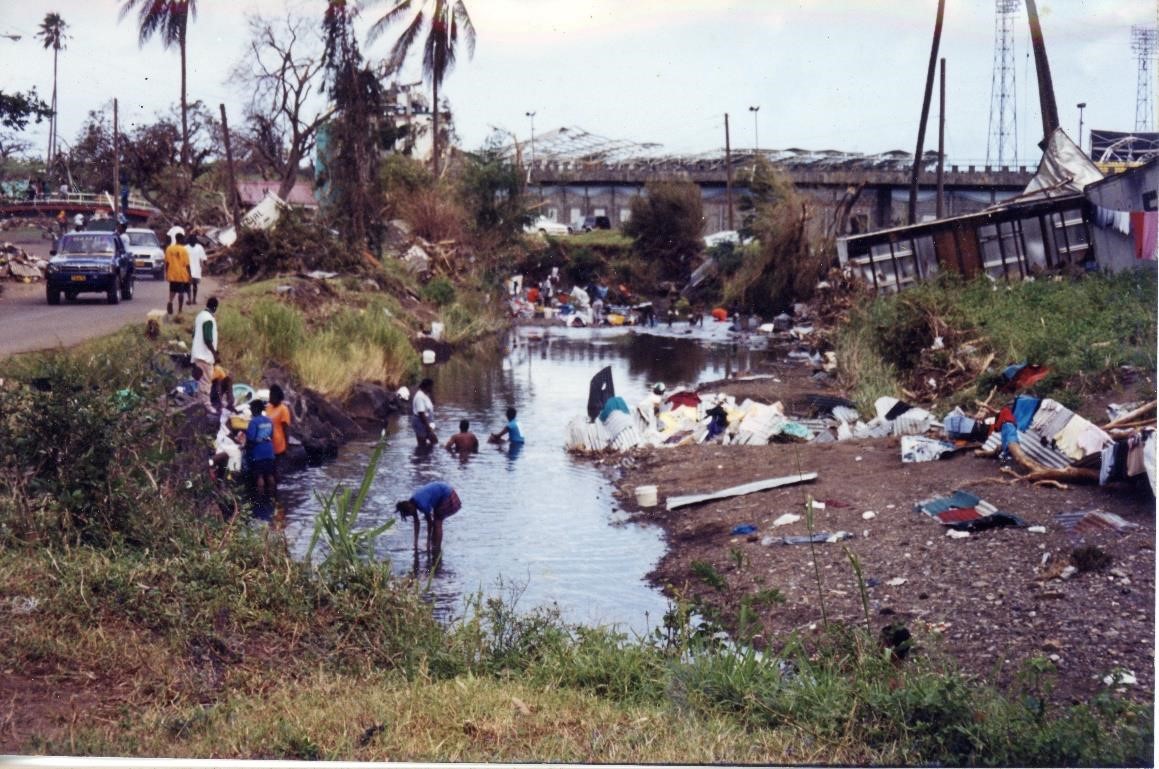
Stadiums in the background and debris litter everywhere. Photo: Grenada National Museum
The immediate feelings of despair and loss, however, were gradually replaced by hope and supported by a historical resilience and maroon spirit that have been a part of Grenadians’ social DNA for generations through their struggles against enslavement and colonialism (Maidman 2006).[1] “Build back better” and “We will rise again” became 2 of many slogans to motivate the population to rebuild their lives and communities, despite the almost sardonic visit by Hurricane Emily in July 2005 that did further damage to the northern part of the island and Carriacou (George 2004; Super P 2005). In fact, the post-hurricane Grenadian landscape had been changed so quickly from its ghostly mien to one of liveability and normalcy that the island was complimented in having achieved so much in so short a time (World Bank, 2005; UNDP Barbados and OECS 2007).
Grenada’s recovery was even viewed as a model in the way Small Island Developing States (SIDS) should approach and deal with hazards like hurricanes (Marsh 2005; UNDP Barbados and OECS 2007). Others believed that Ivan was sent to make Grenadians take stock, as voiced by Collins (2007:14): “…so Nature say, Ivan will have to be in a rage to get any kind of reaction. And is so it happen. Ivan drag us kicking and screaming into the twenty-first century, drop us down with nothing and say, wake up! This is where you is! Start to build!”
The experience of Hurricane Ivan in Grenada is but one example of how an event, in this case a natural hazard, can transform a landscape (in this case an entire island’s land and seascapes), especially in the blink of an eye. But landscapes are resilient, ever changing, constantly adopting, forever being moulded by and moulding those who engage and interact with them. And landscapes are all encompassing, they retain the seeds of change, the scares of invasions and settlements, the pain of subjugation, the chains of enslavement, the calligraphy of beliefs etched on rocks, the strength of survival in memory, the remains of our remains. But also, the celebrations of life through scenic beauty of sprawling vistas, plants that heal, rivers that erase sorrow or quench thirsts, soils that grow plants and nourish bodies, trees that shade and bring forth delicious fruits, they carry our dreams and fears, the embodiment of who we are, who we want to be, who we will always be, how we will be represented, and how will this changing landscape create, mould and shape our identities and sense of place.
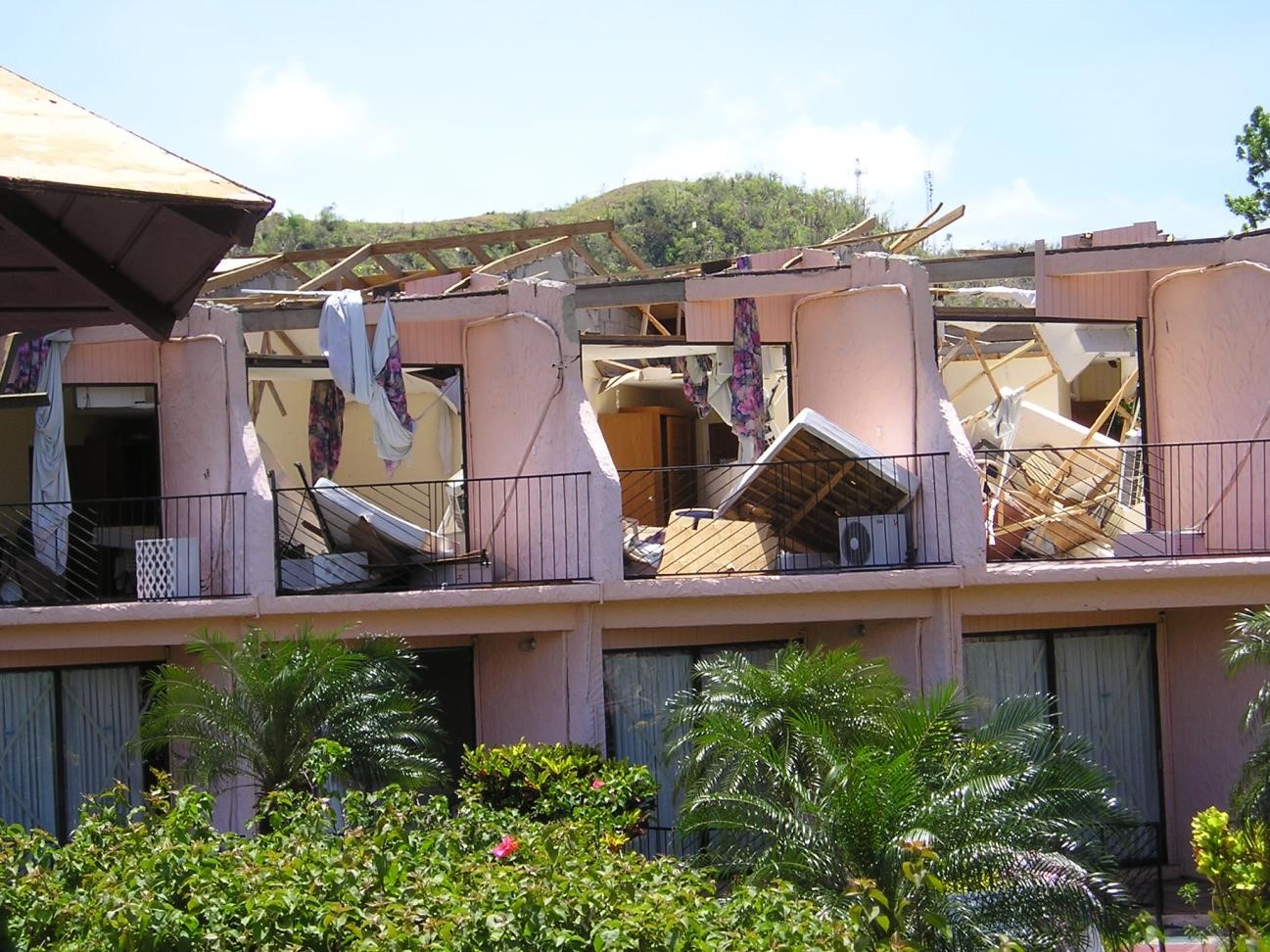
In the hours, days and weeks following the passage of Hurricane Ivan, its impact upon the landscape was writ clearly in the leafless trees, roofless houses, denuded forests, downed powerlines, broken spirits, and devastated lives. The landscape embodied the destruction that was felt and seen by those who had experienced it, affecting almost every aspect of their lives. As the months, years and decades rolled by the immediate impacts faded as the trees and bushes blossomed, houses rebuilt and lives recovered, covering up, hiding, or altogether obscuring the recent past, the destructive past. For many, things appeared as having returned to normal. Yet it was not like it had been before. Hurricane Ivan had fundamentally altered the Grenadian landscape, much like Hurricane Janet did 5 decades before, the Grenada Revolution, the Covid-19 pandemic, and other natural, socioeconomic, political, cultural and technological forces have done throughout the island’s history (Butler et al. 2019; Brizan 1998; Steele 2003). Hurricane Ivan had redirected the trajectory of the biography of the Grenadian landscape, writing a new chapter that would now influence the rest of the story like popular Internet fan fiction. That story of how people use land, how people interact with the landscape, how people continue to represent themselves in that changing landscape, and ultimately how Grenadians create and recreate a sense of place within their constantly changing islandscape.
Today, 2 decades after Grenada experienced the devastation wrought by Hurricane Ivan, the feeling that things have returned to “normal” is pervasive and even instills national pride in that achievement. However, many would readily admit that the Grenadian landscape has been forever altered by the passage of Ivan and what followed in its immediate aftermath; there is often a “pre-Ivan” and “post-Ivan” reference to life on the island. Despite weathering the storm and rebuilding, retooling and reimagining, there is a consciousness, a memory, a fear, a feeling (of loss) that the landscape has been remade, has been rewritten, absorbing the destruction and desperation of those dreadful days and the sense that everything, no matter how normal, how same, is different.
Though there are still signs of old buildings and infrastructure that linger with the damage of Hurricane Ivan 2 decades on, the change is written deeper (many Grenadians lost personal mementos like photographs, other family heirlooms, and a sense of security), much deeper than can be seen unless you peel back the layers like Hurricane Ivan did and look deeper.[2] And there you may see a growing consciousness of the environment, of the landscape and the seascape—forests, trees, rivers, lakes, beaches, coral reefs, the dwindling wildlife, eroding coasts, fishing villages, subsistence farmers, cocoa farmers, historic buildings, crumbling old fortifications, the decaying relic plantation landscape, folk stories, storytellers, French patwa our grandparents spoke, English Creole we speak, folk remedies, the old folks themselves—and the prospect of losing them to climate change or other threats like these intense hurricanes, unsustainable development, or a possible tidal wave from Kick-em-Jenny sub-marine volcano, or just plain time. If only we can harness this sense of fragility of our landscape and seascape, and encourage that desire to protect and nurture the place that surrounds us, that sustains us, that encompass our hopes and dreams for the future of our island home, for our children and grandchildren.
[1] A maroon is the coming together of community members to assist one of their own in building a house or harvesting crops, with payment in a meal. It derives from the name for runaway slaves who created communities in the mountains to survive. It became a common practice after slavery and has all but disappeared from Grenada’s modern labor negotiations.
[2] I remember how we took it as a joke when you asked older persons their age and the response was that they had lost their birth certificate during Hurricane Janet, but the losses suffered during Hurricane Ivan brought that irreplaceable loss home to everyone.
References
Allen, C.D., S.L. Diller, and T. Zabarauskas. 2017. “Grenada: Isle of Spice.” In C.D. Allen, ed., Landscapes and Landforms of the Lesser Antilles. Dordrecht, Netherlands: Springer.
Brizan, G.I. 1998. Grenada: Island of Conflict. Oxford: Macmillan Caribbean.
Butler, A., I. Knez, et al. 2019. “Foraging for Identity: The Relationships Between Landscape Activities and Landscape Identity After Catastrophic Landscape Change,” Landscape Research 44(3):303-319. DOI:10.1080/01426397.2019.1580352.
Caribbean Compass. 2004. “Ivan Hits Below the Belt,” Caribbean Compass, October 2004. [Accessed 27 February 2019 at Link].
Collins, M. 2007. “Tout Moun Ka Pléwé (Everybody Bawling),” Small Axe 22:1-16. [Accessed 27 February 2019 at Link].
Cooper, J. 2012. “Fail to Prepare Then Prepare to Fail: Rethinking Threat, Vulnerability, and Mitigation in the Precolumbian Caribbean.” In J. Cooper and P. Sheets, eds., Surviving Sudden Environmental Change: Answers from Archaeology. Boulder: University Press of Colorado.
Cunningham-Hill, S. 2004. “Ivan the Terrible,” Independent, Sunday 5 December 2004. [Accessed 27 February 2019 at Link].
Economist. 2017. “Paradise Lost: How Hurricane Irma will Change the Caribbean,” The Economist, 14 September 2014. [Accessed 27 February 2019]
Entrikin, J.N. 2011. “Geographic Landscapes and Natural Disaster.” In J Malpas, ed., The Place of Landscape: Concepts, Contexts, Studies. Cambridge, MA: MIT Press.
George, D. 2004. “Grenada Will Rise Again” [Song]. Grenada Will Rise Again. Produced by Denison George. Vie Records. CD. [Accessed 27 February 2019 at Link].
Glenn, M.E. and K.J. Bensen. 2008. “Forest Structure and Tree Species Composition of the Grand Étang Forest on Grenada, West Indies, pre-Hurricane Ivan,” Caribbean Journal of Science 44(3):395-401.
Holmes, T.J. 2006. York House Conservation Project, Upper Church Street, St George’s, Grenada. St George’s, Grenada: Government of Grenada.
Holmes, T.J. and M. Jessamy. 2006. Conservation Project for the National Museum of Grenada and Valorizaion of the Compound, Monkton Street, St George’s, Grenada. St George’s, Grenada: Agency for Reconstruction and Development, Government of Grenada.
Keens-Douglas, P. 1976. “Storm Comin,’” Tim Tim. Port-of-Spain, Trinidad: Keensdee Production Ltd.
Khalid, F. and R. Babb. 2008. “Hazard and Risk Assessment from Hurricane Ivan (2004) in Grenada Using Geographical Information Systems and Remote Sensing,” Journal of Maps 4:sup1:4-10, DOI: 10.1080/jom.2008.9711030.
Maidman, D. [2006]. Grenada: The Maroon Spirit. [Canada]: Pumkinhead Production.
Marsh, B. 2005. “Grenada Bounces Back from Storms,” The Denver Post, Travel section, 26 July 2005. [Accessed 27 February 2019 at Link].
McIntosh, N.A. 1956. Hurricane Janet in Grenada and Carriacou, British West Indies. Complete
Story and Pictures of the “Night of Terror,” September 22, 1955. Bridgetown, Barbados: Printed by Advocate Co, Ltd for Hankeys Ltd.
Murphy–Larronde, S. 2006. “Comeback Island”
OECS. 2004. Grenada: Macro-Socio-Economic Assessment of the Damages Caused by Hurricane Ivan, September 7, 2004. Organization of Eastern Caribbean States. [Accessed 27 February 2019 at Link].
Peters, E. 2017. “Ivan [13th] Anniversary” on GBN News. Grenada Broadcasting Network. [Accessed on 27 February 2019 at Link].
Peters, E.J. 2010. “Impact of Hurricane Ivan on Grenada Water Supply,” Proceedings of ICE: Water Management 163(WM2):57-64.
Richardson, B.C. 1997. Economy and Environment in the Caribbean: Barbados and the Windwards in the late 1800s. Gainesville: The University Press of Florida.
St George’s, Grenada: Caribbean Monument. 1988. St George’s, Grenada: OAS/CARIMOS (Plan for Monuments and Sites).
Steele, B.A. 2003. Grenada: A History of its People. Oxford: Macmillan Caribbean.
Super P. 2005. “We Shall Rise Again (Ivan).” D’Soca Zone: 5th Spin. Written by Foster Straker. VP Records. CD. [Accessed 27 February 2019 at Link].
Tilley, C. 2006. “Introduction: Identity, Place, Landscape and Heritage,” Journal of Material Culture 11 (1/2):7-32.
UN ECLAC. 2005. Grenada-A Gender Impact Assessment of Hurricane Ivan: Making the Invisible Visible. [S.l.]: United Nations Economic Commission for Latin America and the Caribbean. [Accessed 27 February 2019 at Link].
UNDP Barbados and OECS. 2007. Post-Disaster Early Recovery in a Caribbean Small Island Developing State: The Case of Hurricane Ivan in Grenada (2004) – Best Practices and Lessons Learned. Hastings Barbados: UNDP Barbados and OECS. [Accessed 27 February 2019 at Link].
Watts, S.D. 2011. “Environmental Practices and the Vulnerability of Rural Livelihoods to Natural
Disasters: The Differential Impacts of Hurricane Janet and Hurricane Ivan Upon Mangrove-
Dependent Livelihoods in Grenada.” International Development, St Mary’s University, Canada. MA Thesis.
Wilson, M. 2004. “Britons Flee Storm-hit Island Amid Looting,” The Telegraph, 10 September 2004. [Accessed 4 March 2019 at Link].
World Bank. 2005. Grenada-A Nation Rebuilding: An Assessment of Reconstruction and Economic Recovery One Year After Hurricane Ivan (English). Washington, DC: World Bank. [Accessed 27 February 2019 at Link].
Worme, S.M. 2005. Ivan the Terrible in Grenada. St George’s, Grenada: The Author.








The photographs and narrative of Ivan’s misconduct remind us of Mother Nature’s awesome power and the unpredictability and vulnerability of our existential sojourn. The writer should be commended for the hard work in compiling such a vivid and encapsulated account of one of the most memorable moments in the nation’s history. Reading the article was like being a spectator to the events. The writer truly brought home what it was like for those who endured the ordeal; especially the shot of the folks doing laundry in St. John’s river.