







by Jonathan Hanna, PhD, RPA
In Egmont, million-dollar mansions now stand where Maurice Bishop’s body was last seen — burned in a pit after the 19 October massacre.
No one checked the ground before building. No one asked if evidence remained. No one seemed to care. If Grenadians don’t value their own history, why would anyone else? Bishop’s story is a microcosm of Grenada’s heritage today: important history, known locations, legal protections on paper — and yet, nothing done. The same pattern plays out at enslaved burial grounds, Amerindian sites, and colonial-era locations across the island.
The irony is striking: a National Heroes Park is set to open adjacent to Camerhogne Park this weekend (itself the site of an African burial ground discovered in the 1960s and an Amerindian site found in the 1980s). Yet as we prepare to honour our heroes, we’ve done nothing to solve an enduring mystery surrounding one of Grenada’s greatest heroes.
Background
Two years ago, the Washington Post did an excellent podcast series called The Empty Grave of Comrade Bishop, which pulls together the story of 19 October and its aftermath, as best as is currently known. In summary, we know that the US found at least 5 individuals in a burn pit at Camp Fedon in Calivigny (now Egmont), but whether or not Bishop’s remains were ever recovered is an open question. Aside from being torn apart by machine gun fire and burned on 19 October, the burn pit was later hit by unguided aerial ordinance 5 days later during the American “Inter-vasion,” pulverising the remains further.
A St George’s University (SGU) professor Dr Robert Jordan recounted that the remains he examined were thoroughly decomposed and “comingled,” making identification reliant solely on large bones, context, and associated artefacts. No intact skulls were found, and only a few teeth. He reportedly identified a female pelvis and dress likely belonging to Jacqueline Creft, as well as jewellery and a wallet related to Norris Bain, Fitzroy Bain, and Evelyn Maitland. None of the long bones indicated a stature beyond 6 ft 1 in, suggesting that Bishop’s 6 ft 3 in remains were not included. And while the number of individuals is based on unique elements to create a basic MNI (minimum number of individuals), it is unlikely that all 8 victims were included in the remains analysed at SGU.
A Caribbean peace-keeping force, conducting its own investigation, visited the pit weeks later and found additional items, including the Mechanics Lodge ring of Norris Bain and possibly a bracelet belonging to Bishop. This suggests that the excavation only recovered large bones and items, rather than smaller things like bone fragments, teeth, or other small items. Photographs of the retrieval do not show standard archaeological or forensic sifters or screens that would capture such items. As such, it is quite possible that some smaller remains — if not large ones — were left in the ground at Egmont.
Why doesn’t Grenada protect its heritage?
In 2003, the government sold the lands of the former People’s Revolutionary Army (PRA) base to a private developer, who began constructing million-dollar mansions across the area. As far as I am aware, no impact assessment was ever conducted — certainly, no one seemed concerned that evidence from one of the most important events in recent Grenadian history could be destroyed. How could this have happened? Had trained, non-partisan officials been in charge of [the Ministry of] Planning at the time, they likely would have required an Environmental and Social Impact Assessment (ESIA). Indeed, the Physical Planning Act of 2002 required impact assessments for “subdivisions of more than 10 lots” and/or “residential developments of more than 25 units,” both of which should have applied to Egmont.
The Physical Planning law has been updated several times since, but ESIAs are only occasionally conducted, and their recommendations are invariably ignored afterwards. There are also at least 17 additional laws that speak to Grenada’s cultural heritage, for example, in environmental sustainability, in traditional ecological knowledge, in Crown Lands, in lands managed by the Forestry Department, in Museum management and documentation, in climate change policy, in roadworks, in tourism development, and many other situations. Grenada’s 2012 Cultural Policy also encourages the restoration and maintenance of archaeological and historical sites in the country, as well as the recovery, protection, and display of artefacts and other cultural property. Yet despite robust legal frameworks, Grenada’s heritage continues to hang in the balance.
Grenada must do better. This isn’t just about the past. Heritage tourism brings in millions. Archaeological sites tell us who we are, and once these time capsules are destroyed, they’re gone forever — no second chances, no do-overs. Our grandchildren will have to travel to Barbados or some other island to see Amerindian petroglyphs, enslaved African burial grounds, and other remains of their history because Grenada did not protect those things.
The pattern repeats across the island. In 2016, enslaved African house foundations at La Poterie — discovered, documented — were soon graded over for a basketball court rushed before an election. At Sauteurs, an ill-conceived breakwater continues to destroy dozens of Amerindian burials, year after year, with no resolution in sight. At La Sagesse, bulldozers have now destroyed a unique pre-Columbian/contact-period site where African and Amerindian graves were found side by side in the 1990s. A pre-school was built atop one of Grenada’s earliest sites and burial grounds in Beausejour, and the same is now happening at Pearls, Grenada’s largest and most well-known Amerindian site. Only one of these (La Sagesse) was a foreign developer. If the government does not follow its own laws, why should they?
The problem is not simply “government” of course, but Grenada’s lack of strong, independent institutions. Where were the nation’s other cultural and heritage organisations when these things happened? Grenada’s institutions seem only to function through the will and drive of a single person, leaving the organisation to crumble when they burn out or retire. Political parties have long exacerbated the situation by both packing these institutions with party insiders after winning power and leaving key technical roles unfilled, rewarding supporters with top jobs, board appointments, lucrative contracts, and other spoils — despite their lack of qualifications, expertise, or project management competence.
In the case of Physical Planning, it is now supposed to be an independent “authority,” yet it is perpetually understaffed and underfunded. It currently has no Natural and Cultural Heritage Advisory Committee, no ESIA review committee, no regulations from the 2016 Act (only those from the 1988 version), and no publicly available policies on how ESIA processes are managed or enforced. This is why there is little to no oversight on controversial projects like Levera, La Sagesse, or Mt Hartman, even after a change in government.
There may still be time
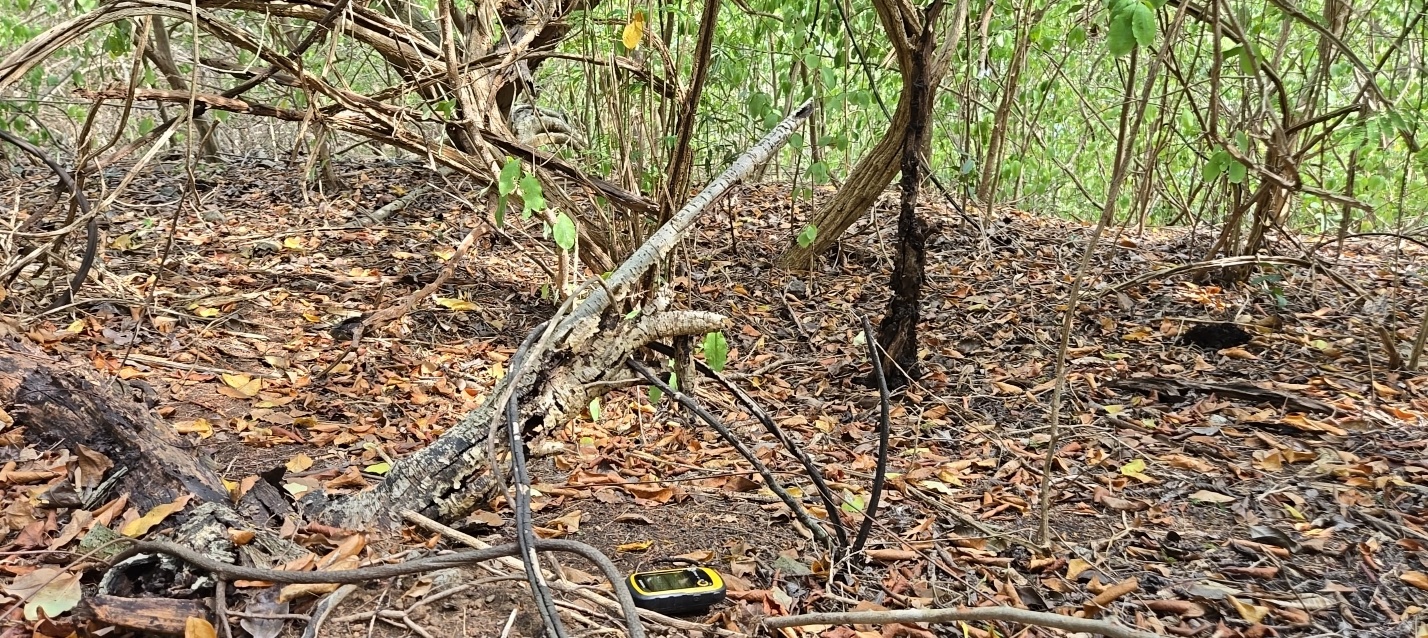
I recently contacted Martine Powers, the journalist behind the Washington Post series, to see where she thought the burial pit was, based on interviews, etc. She had a good idea, and in 2022, she went to see for herself. Unfortunately, a new house was being constructed there at the time, suggesting we had just missed the opportunity by a year. Again, why was no ESIA conducted beforehand (in 2022 at least)? Last week, I went to see for myself and found an overgrown lot adjacent to that house with a large rectangular depression. Could this be the location of the pit? Would anything remain there after 42 years? Without permission and resources to excavate, we’ll never know for certain. And if the site remains unprotected, even that possibility may soon be lost.
An election is coming soon. We can let the default continue, or we can demand that candidates commit — on record — to enforcing heritage protections, funding impact assessments, and protecting what remains. ESIA’s cost little in comparison to the costs of construction and development, and they need not take much time at all — there’s simply no excuse for skipping them.
Those who know what happened in 19 October 1983 might be dead or silent, but answers may still lie in the soil. The question is: will we choose to look before it’s too late?










In the case of Maurice’s body, why is it not asked of the presently at-large and still active RMC-sympathizer faction about details of the 19 October 1983 matter. It is an issue they have long denied and/or pledged ignorance about to the extent that they even blamed the invasionary forces of 25 October 1983 for removing the bodies. Guess they would have pinned the actual execution on those same forces if it was possible but the dates of those telling events would never match being approximately one week apart.