



by Curlan Campbell
- SIDS Exclusive Economic Zones are, on average, 28 times larger than their land mass
- UNESCO’s legitimacy rests on something very simple: every voice must count
- Lauded Grenada’s participation in COP29 and recent United Nations Ocean Conference in Nice
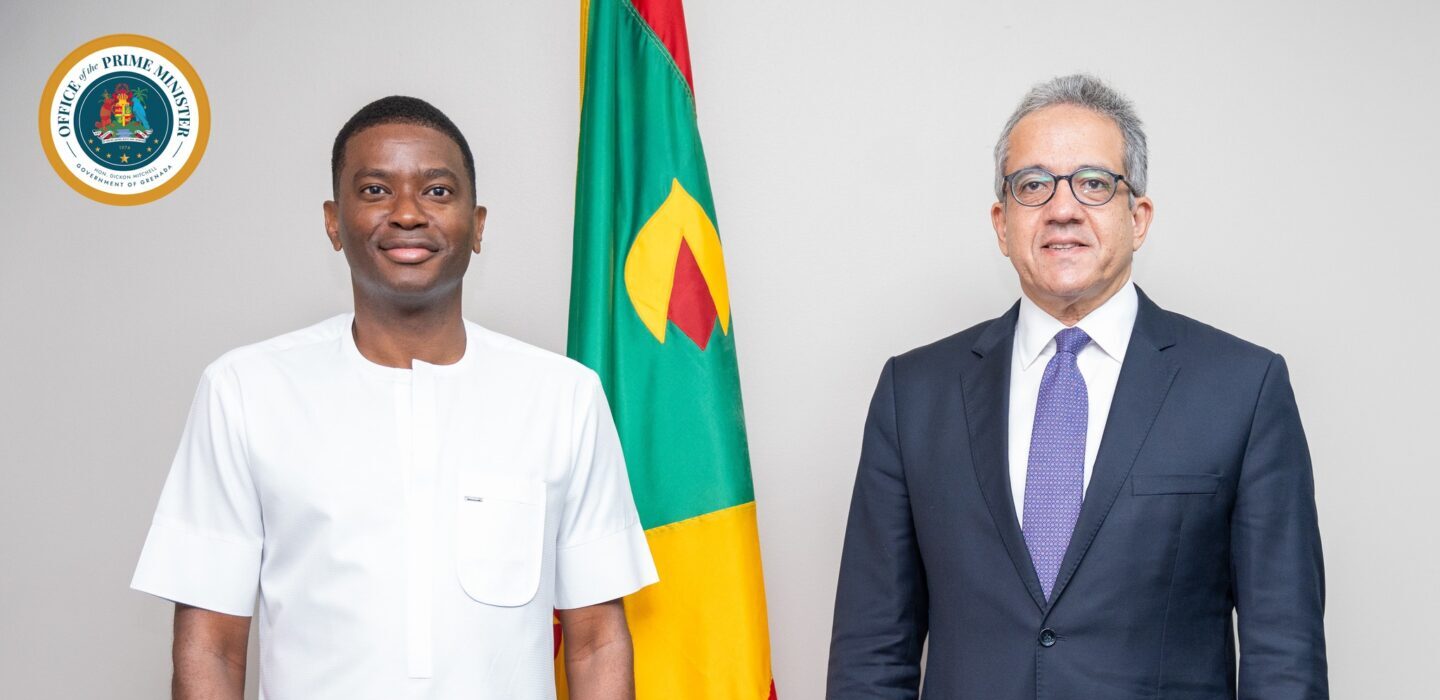
Dr Khaled El-Enany, candidate for Director-General of UNESCO, is making a strong case for equitable representation of smaller nations within the organisation’s decision-making structures — a message he plans to reinforce following his visit to Grenada.
“Inclusive leadership is not a slogan. It is a governance imperative,” said Dr El-Enany. “UNESCO’s legitimacy rests on something very simple: every voice must count. Only then can the organisation live up to its universal mandate — not in theory, but in practice.”
He emphasised that Small Island Developing States (SIDS) such as Grenada are often underrepresented in international forums, despite playing an outsized role in tackling global challenges like climate change, ocean governance, and cultural heritage protection. “Small Island Developing States may account for less than 1% of the world’s population, but their Exclusive Economic Zones are, on average, 28 times larger than their land mass. Their expertise does not only matter regionally. It matters globally.”
Dr El-Enany’s visit to Grenada is part of a broader diplomatic campaign that has taken him to more than 55 countries. He views SIDS not as peripheral actors, but as central to UNESCO’s mission in the 21st century. “Too often viewed solely through the lens of vulnerability, and perhaps above all spaces of innovation, resilience, and solutions.”
A key focus of his visit was to listen directly and intentionally to the perspectives of national leaders, educators, scientists, cultural stakeholders, and young people. “What I seek from this visit… is a direct, honest dialogue… Because these are the people who bring UNESCO’s values to life,” he said.
Dr El-Enany also lauded Grenada’s leadership on the global stage, including its participation in COP29 and the recent United Nations Ocean Conference in Nice. He singled out the contribution of Grenada’s Climate Ambassador Safiya Sawney who declared: “There can be no ocean declaration without SIDS.” According to Dr El-Enany, that message resonates deeply with his own vision of placing small island States “at the very heart of global ocean governance.”
If elected, he intends to bolster UNESCO’s Intergovernmental Oceanographic Commission (IOC), which he described as “a crucial instrument for SIDS, particularly in areas like seabed mapping, plastic pollution, and ecosystem monitoring.” He added, “Ocean governance must be elevated to the same level of urgency and visibility as artificial intelligence, climate finance, or digital education.”
Dr El-Enany’s broader reform agenda includes transforming UNESCO into a more responsive and collaborative institution. “We must move away from top-down logic toward a culture of co-construction,” he said. “What Member States expect today… are solutions that are tailored, grounded in national priorities, and built collaboratively from the start. This requires a deeper culture of listening, a more consistent field presence, and long-term partnerships with communities, educators, researchers, artists, and civil society,” he explained.
His personal connection to UNESCO dates back to his student days in Egyptology, when he visited Abu Simbel — the ancient site famously saved by a UNESCO-led international effort. “That day, I understood that heritage is not just a legacy of the past. It is an act of solidarity. A force that unites people across borders,” he recalled.
Now, as he brings his campaign to Grenada, Dr El-Enany reaffirms his commitment to making UNESCO more inclusive, more agile, and more grounded in the voices of all its Member States no matter their size or influence. “Countries like Grenada are not asking for symbolic recognition. They are asking to be considered in proportion to what they contribute. And they are right to do so.”
Endorsed by both the African Union and the League of Arab States, his candidacy is also backed publicly by over ten Member States of UNESCO’s 58 Executive Board countries — including France, Germany, Austria, Spain, Brazil, Türkiye,— in addition to many other countries from different regions, expected to vote for hjm in the secret ballot expected next October.


Why should small nations have an equal voice with huge nations? This system is why the United Nations is such a wierd mess. As long as small nations have sufficient access to ledership to bring unusual problems to the light of the world that should be sufficient I think