






by Curlan Campbell
- Two bills are part of Grenada’s participation in UN Spotlight Initiative
- Independent Caucus for Constitutional Reform staged silent protest on Thursday
- Demanded withdrawal of bills to allow for public consultations
Members of the Independent Caucus for Constitutional Reform rallied against controversial bills, particularly one that would allow minors aged 16 years or older to access sexual and reproductive healthcare without parental consent.
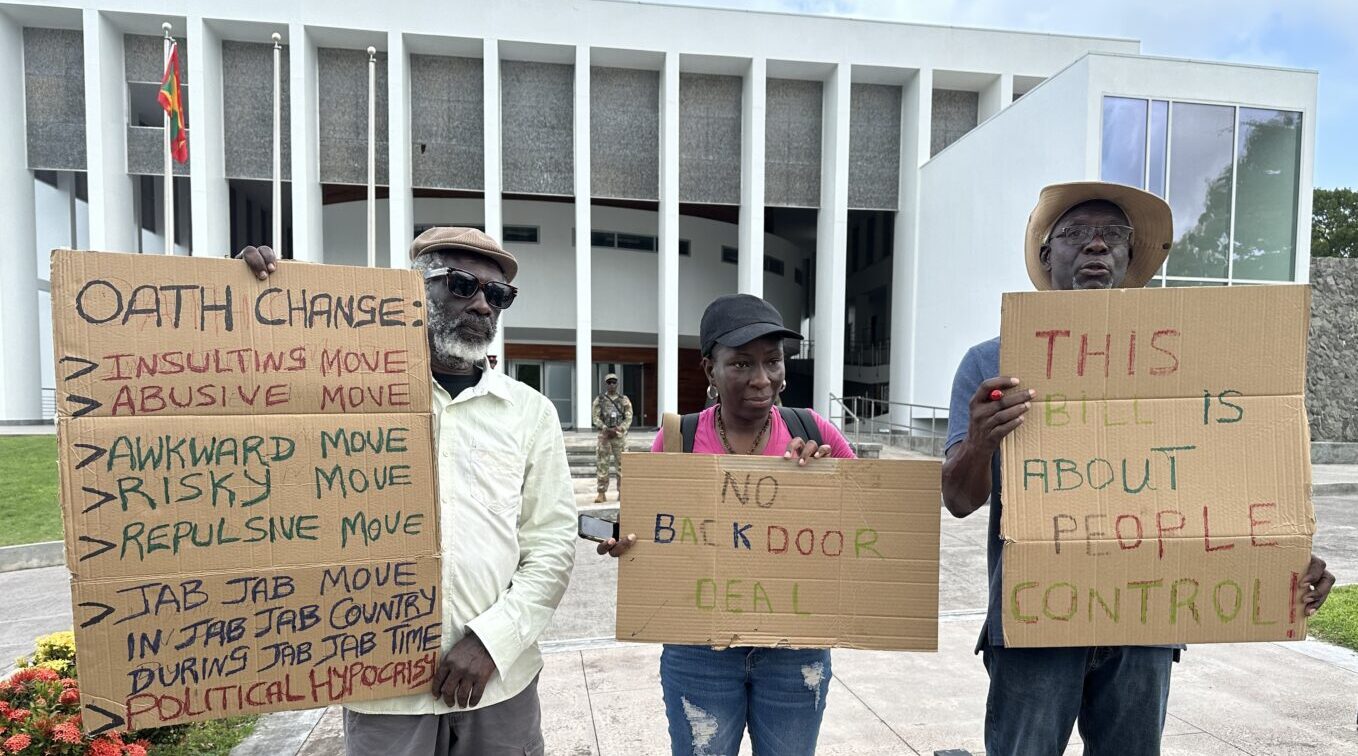
The members staged a silent protest with placards directly in front of the Parliament building on Thursday, 24 July, demanding the complete withdrawal of these bills to allow for public consultations.
Government introduced 3 pivotal pieces of legislation as part of the Spotlight Initiative: the Status of Children Bill 2025, the Marriage Amendment Bill 2025, and the Age of Civil Legal Responsibility Amendment Bill 2025.
The bills are part of Grenada’s participation in the United Nations’ Spotlight Initiative, a global program targeting violence against women and girls, and are designed to enhance children’s rights, eliminate gender discrimination, and expand adolescent access to sexual and reproductive healthcare. On Thursday, the 3 bills had their first reading, which means they were presented but weren’t debated or passed.
Social media has been divided over whether the proposed bills could infringe on the rights of parents, sparking public concern that the government is seeking to address.
The bills proposed include the Status of Children Bill 2025, which aims to improve the existing Status of Children Act by providing greater certainty and eliminating discrimination based on the birth status of children. It seeks to ensure that all children are treated equally under the law, regardless of their parents’ marital status. The Marriage Amendment Bill 2025 raises the minimum age for valid marriages to 18 years, thereby protecting minors from early marriages. Under the current Marriage Act, only marriages involving a child under 16 are void. This amendment not only sets a higher age threshold but also allows individuals aged 18 and older to marry without needing parental consent. The Age of Civil Legal Responsibility Amendment Bill 2025 proposes that minors aged 16 or older be allowed to access sexual and reproductive healthcare without parental consent, especially in cases where their health or wellbeing may be at risk, even if their parents oppose such access.
Prime Minister Dickon Mitchell defended the intent behind the latter bill during a recent airing of the social media programme “DM with the PM” stating, “We are trying to address instances where young people need access to sexual or reproductive health… but their parents will either not consent to their detriment, or the children are unable to even have conversations with their parents about it.” He added, “We have instances where men are sleeping with their daughters… If the child needs health treatment, in those circumstances, is she able to go to the very perpetrator, her father, to ask his consent to go see the doctor? Of course, he will deny it.”
The Prime Minister emphasised the bill’s focus on health and education access. “This is not about trying in any way to prevent parents from having control over the children. So it is related purely to reproductive and sexual health care.”
Despite government reassurances, civil society groups and activists have raised serious concerns about the process behind the legislation and its potential implications.
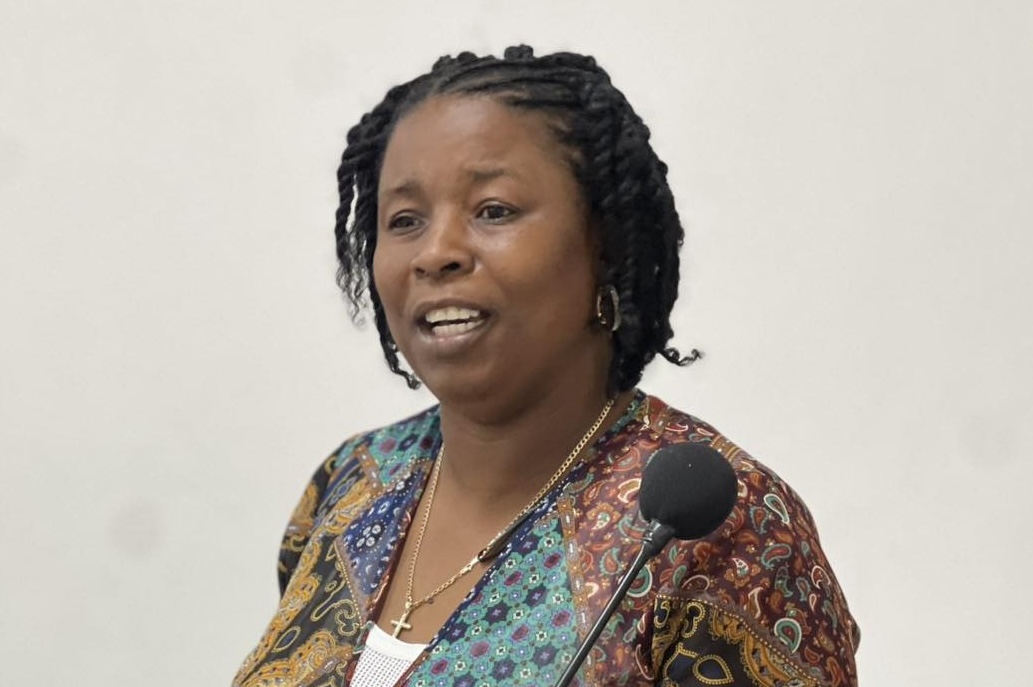
Casandra Mitchell, Executive Director of the Caribbean Association for Youth Development and former co-chair of the Civil Society National Reference Group under the Spotlight Initiative, criticised the lack of public consultation. “No one was consulted on this bill to get input… There was a proposal to have a draft bill that addresses sexual and reproductive health for adolescents. I don’t think that there was any talk about the age of civil legal responsibility.”
Mitchell also warned of constitutional conflicts that will arise if the bills are passed into law. “The legislation… is unconstitutional when you look at Section 9, subsection 2, of the Constitution… though it addresses Freedom of Conscience, it does say, with no ambiguity, that if a person is 18 years and under the consent of the guardian is needed… An Act of Parliament cannot change that.” She called for the bills to be withdrawn entirely to facilitate public consultations. “We are calling for the total removal of the bills from the Order Paper and engagement with stakeholders who these legislations are going to affect.” She further expressed fears about unintended consequences. “A father who is sexually abusing his daughter can quietly send her to get a contraceptive so that he can continue to abuse her without the risk of pregnancy… This is a pervert’s fantasy.”
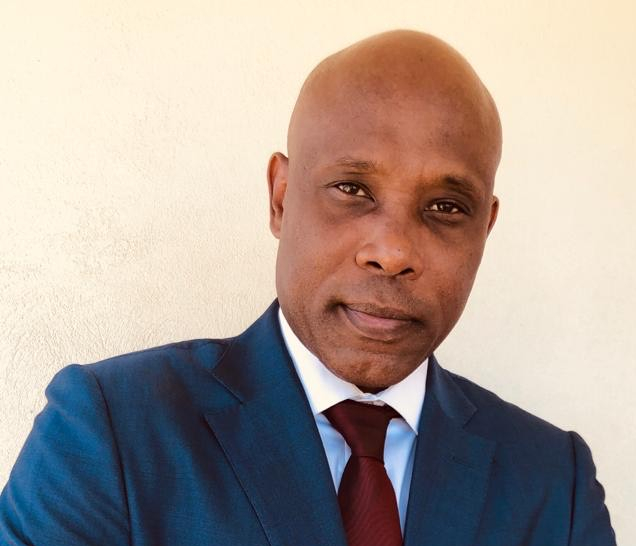
Activist Joseph Roberts tied the proposed laws to international influence with hidden agendas, particularly the Samoa Agreement. “So many of our legislations and the changes in the Constitution… could be well part of the United Nations directive, and it’s the Samoa Agreement… We are to be very cautious.” He also condemned what appeared to be the use of state security to manage dissent. He was referring to armed members of the Royal Grenada Police Force (RGPF) who sought to question their motive while engaging in a peaceful demonstration in front of the Parliament building. “It’s very sad when the nation can use the State Security… to show an indication of intimidation.”
Meanwhile, Davidson Ned, representing the Independent Caucus for Constitution Reform, argued the bills are being pushed without a proper democratic process. “Our laws are being domesticated now, and it’s being domesticated without the consent of the people… It’s not coming from the people, and it’s not genuine representation.” Ned also questioned the appropriateness of civil liberties for minors. “What does a 12-year-old know about a contract that makes him responsible for anything? That’s not in our culture.”
While the bills are still at the first reading stage, public backlash continues to mount. Mitchell, Roberts, and others are calling for the government to halt the legislative process and return to broad-based consultations involving parents, religious groups, civil society, the legal community, and health professionals.
Despite the controversy, Prime Minister Mitchell stood firm on his administration’s commitment to improving access to healthcare and education for vulnerable youth. “If I have to come down on making sure that persons who are 19 have access to sexual education and have access to reproductive health care, I will come down on their side.”
The nation now awaits the next move from the government as debate over the bills — and the future of children’s rights in Grenada — continues.








In my humble opinion this bill stems from the SAMOA Agreement.