













by Curlan Campbell
- Children’s perceptions of death heavily influenced by direct encounters
- Child’s understanding of death shaped by personal experiences and developmental stage
- A child under 5 years is often oblivious to concept of death
The common phrase suggesting that a loved one who has passed away is with Jesus, although often well-meaning when spoken by a concerned adult to a grieving child, can have serious consequences. Bereavement counsellor Ceirid Sampson indicated it may hinder a child’s ability to process their loss and could lead to psychological issues later in life.
Sampson believes it is important to be cautious when speaking to grieving children about the loss of a loved one, and warns against common mistakes that adults make in these conversations.
During an interview on how parents or loved ones can better support a grieving child, Sampson explained that when informing a child about the loss of a parent, phrases like “Daddy has gone to heaven” or “Mommy has gone to heaven; she’s now with Jesus” can lead to misunderstandings. She said at this present moment a child may interpret this to mean that if they want to be with Mommy or Daddy, they need to go to heaven as well. This could lead them to think that dying is the only way to reunite with their parent. “They might wonder, ‘Do I want to die at the age of 5 or 10 to be with Mommy?’ We need to communicate these concepts carefully.” Sampson said, “So the right way of saying that is that mommy is no longer with us. Her body stopped working. So we have to be careful [about] the information that we share with children.”
It is widely recognised in the field of child psychology that a child’s understanding of death is shaped by their personal experiences and their developmental stage. Children’s perceptions of death are heavily influenced by their direct encounters with it or the information they receive from others. Due to their limited life experience, children often struggle to understand the inevitability of death for all living beings. They may not fully grasp the finality of death and may find it difficult to accept that it cannot be changed or reversed.
Sampson explained that a child under the age of 5 years, is often oblivious to the concept of death and may ask if the person who has died is coming back. Whereas children older ages of 6 and 11 years more often than not have a clearer understanding of death.
One may wonder: “What is the right age or moment to introduce the concept of death to a child who has just lost a family member, particularly a mother or father?” Sampson notes that while the answer is not always straightforward, the best time to discuss death with a child is when they ask about the absence of a loved one.
“Children today are wiser than they were a long time ago so that the information must be shared. Mommy died. Mommy is no longer with us. What that child will realise is that someone is absent, and unless that child inquires further, you share additional information, I think, more often than not, what you find happening is when different events present themselves in life as that child gets older, that mother figure is going to be asked for and then is when we present them with the answers to those questions, not before,” Sampson explained. “If, for some reason, we put mommy on a back burner and say that mommy died, and you don’t need to know that mommy died, because Granny is now taking care of you. At some point in time, you’re going to ask, where is my mommy, and that’s when you need to answer the questions but answer it in such a way that the child is okay with the responses that they’re getting. So it’s not that you’re hiding it I’m waiting until you are the right age to be able to let you know and feel to be able to understand.”
Sampson provided an example of ineffective communication with a grieving child. “Let’s say for example that the child was told nothing about mommy’s passing, or you have made mommy’s passing very horrific. I’m just giving you, for example, mommy died in childbirth, so mommy didn’t even know who you were, and all the child is hearing is mommy didn’t know who I was, the child is not hearing mommy died in childbirth. He or she is now thinking that Mommy doesn’t, know who I am.”
The bereavement counsellor suggested a strategy for supporting grieving children.
“We try to in the midst of a child losing a parent, to allow them to get that sort of love from someone else, so somebody else steps in, we always replace daddy died, but I have Mommy. Mommy died and Daddy died, but I have granny. We always replace that love with someone else’s love. So again, important to what information you share with children,” Sampson said.
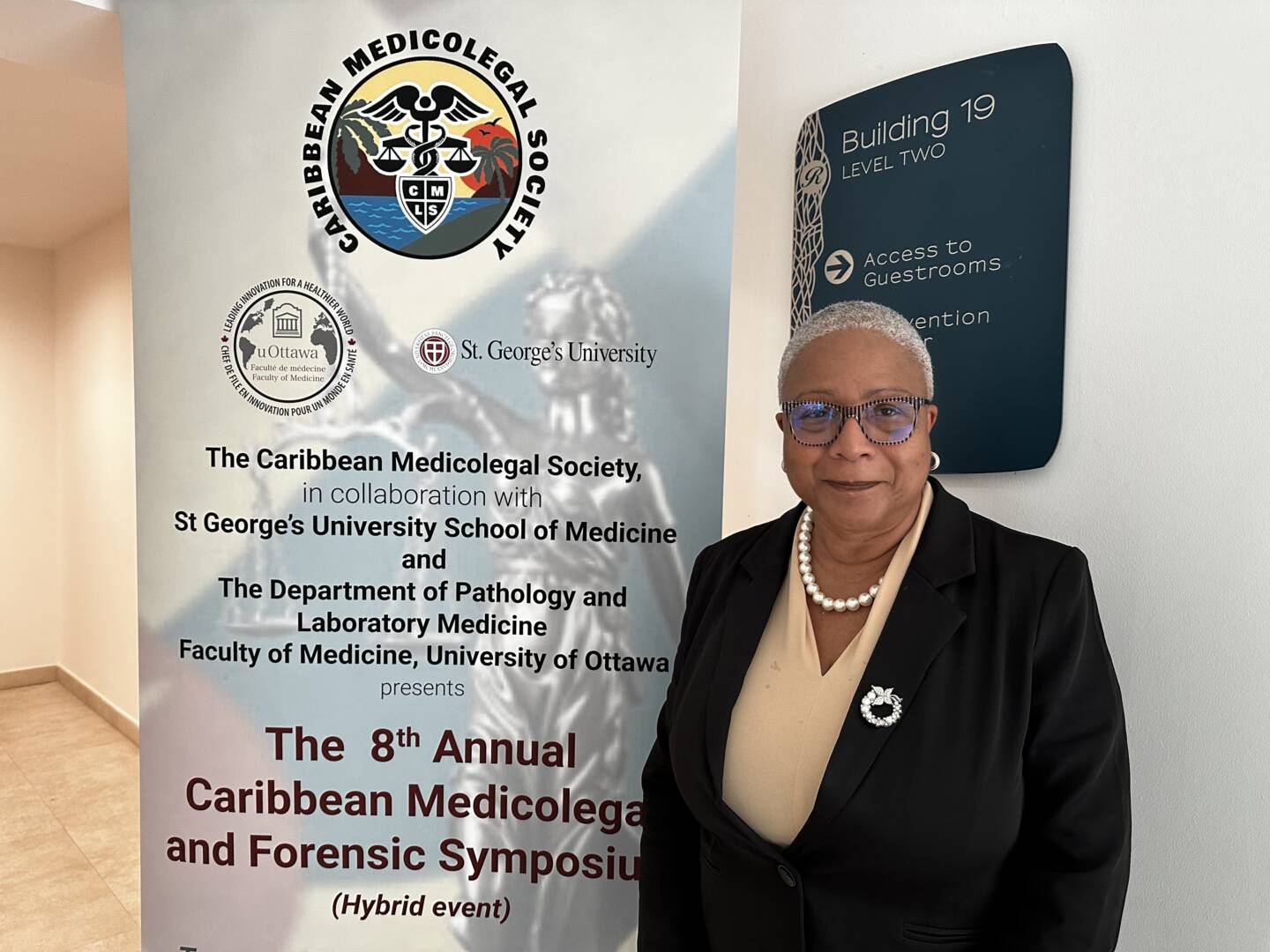
Ceirid Sampson, a bereavement counsellor from Trinidad and Tobago, recently attended the 8th Annual Caribbean Medicolegal and Forensic Symposium held at the Royalton Grenada Resort from 7-9 November 2024, which focused on the theme “Trauma, Death, and Grief: Changing the Attitudes and Practices of Medicolegal Investigations.” The conference was made possible through the collaborative efforts of the Caribbean Medicolegal Society, in collaboration with St George’s University School of Medicine and The Department of Pathology and Laboratory Medicine Faculty of Medicine, University of Ottawa.
Her presentation, titled “Medicolegal Death Investigation: Grief and Death,” addressed the various emotions associated with grief and loss. She emphasised that these emotions can arise from any type of loss, such as the loss of a limb, a relationship, or even a job. Additionally, her presentation highlighted the importance of dignified handling of corpses by pathologists in the context of forensic science.