












by Dr Adrian Joseph
A friend in the diaspora recently sent me an article entitled “Two Caribbean countries added to new US travel restrictions.” My friend asked the question, “Can you imagine the local budget without CBI revenue source?”
I read the article and paused, not because Grenada was named, but because the region has reached what some may describe as a tipping point that exposes systematic policy vulnerabilities. The article indicated that Antigua and Barbuda and Dominica were singled out over concerns linked to citizenship by investment arrangements. The message was unmistakable: global tolerance is shrinking, and small states dependent on “exceptional revenues” must prepare for sharper scrutiny and sudden shocks.
This moment should prompt serious reflection here at home.
In a discussion with another local expert, I asked the same question. She quickly responded, “Grenada’s Fiscal Summary for July 2025 paints a picture that is both reassuring and unsettling.” When one examines Grenada’s Fiscal Summary for July 2025, it tells a story that deserves careful, sober consideration. While overall revenue performance for the first 7 months of the year remained broadly on target, it also confirms something more unsettling: IMA/CBI revenues now form a significant part of Grenada’s fiscal architecture, even as the country continues to operate under deficit conditions.
In plain language, money that was once treated as extraordinary is increasingly helping to prop up ordinary, recurring obligations.
Between January and July 2025, IMA revenues amounted to over EC$117 million. That is not pocket change. More troubling, the fiscal report itself acknowledges that higher transfers and subsidies, including IMA-related expenses, were key drivers of recurrent spending during the period. At the same time, the country recorded both a primary deficit and an overall fiscal deficit.
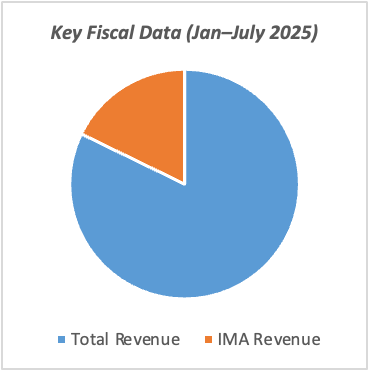
Total revenue: $540 million
IMA revenue: $117 million.
This is where the warning lights begin to flash.
When you look at these numbers in simple terms, the size of the CBI money should make anyone uneasy. About 14 cents of every dollar the government collects now comes from CBI. That means CBI is bringing in almost as much money as import duties, and more than petrol tax, stamp tax, excise tax, and environmental levies put together.
Think of the country’s finances like a household budget. Taxes such as VAT, income tax, and import duties are like a parent’s regular salary. They come in steadily because people work, shop, and do business every day. CBI, however, is more like winning money from a game or getting a big gift from a stranger. It can be a lot of money, but you never know if it will come again next month or next year.
Exceptional revenues, whether from CBI, disaster insurance payouts, or one-off windfalls, are by nature volatile. They can surge one year and evaporate the next, often for reasons entirely outside our control, including geopolitics, regulatory shifts, reputational concerns, or policy decisions taken in distant capitals. The July figures already show how dramatic that volatility can be when compared to the previous year.
So, the question must be asked, calmly but firmly: What happens if the taps slow further, or are abruptly tightened?
Recent regional developments suggest this is not a hypothetical exercise. When major partner countries signal discomfort with how citizenship programmes are structured, monitored, or perceived, the ripple effects extend well beyond the jurisdictions named. The entire Caribbean CBI/IMA space comes under a microscope; banks, correspondent relationships, investors, and international agencies alike.
Grenada may believe its programme is better managed. That may well be true. But prudence demands more than confidence; it demands preparation for what it is.
A responsible fiscal strategy must therefore confront a hard truth: recurrent expenditure should never depend heavily on exceptional income streams. When it does, governments lose room to manoeuvre. Choices become reactive. Adjustment becomes painful.
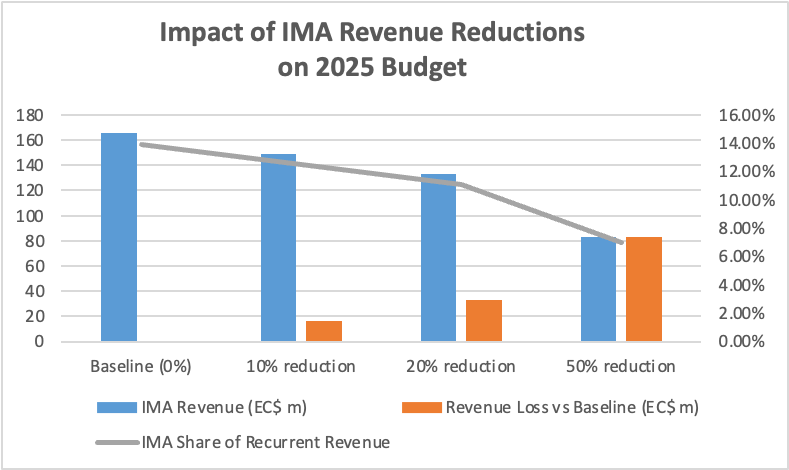
| Scenario | IMA Revenue (EC$ m) | Revenue Loss vs Baseline (EC$ m) | IMA Share of Recurrent Revenue | Change in Total Revenue |
| Baseline (0%) | 165.9 | — | 13.9% | — |
| 10% reduction | 149.3 | 16.6 | 12.5% | −1.4% |
| 20% reduction | 132.7 | 33.2 | 11.1% | −2.8% |
| 50% reduction | 83.0 | 82.9 | 7.0% | −6.9% |
What, then, is the fallback option?
First, Grenada must clearly ring-fence IMA revenues. These funds should primarily support capital investment, resilience-building, debt reduction, and time-bound development priorities, rather than permanent obligations that recur year after year.
Second, the country needs a genuine stabilisation buffer, a savings mechanism that cushions sudden revenue shocks and buys time for orderly adjustment when external conditions change.
Third, domestic revenue mobilisation must improve, not by squeezing the most vulnerable, but by tightening compliance, reducing leakages, and ensuring progressive taxation where contributions align with economic capacity and ability to pay.
Fourth, economic diversification can no longer be a talking point; it must be strategically pursued through deliberate sectoral integration and value chain development. Agriculture and Tourism must become a stronger catalyst of economic diversification and job quality, while agro-processing, manufacturing, and creative industries must become drivers of our New Economy. Simultaneously, digital and professional services must be developed as credible export sectors by leveraging platform economy opportunities and positioning Grenada as a competitive hub for virtual service delivery within the Caribbean and global markets. Imperatively, affordable access to renewable energy and its systematic scaling hold the key not only to reducing fuel import dependency, but to powering economic expansion, enhancing industrial competitiveness, and improving living standards across all income levels
Finally, and this cannot be overstated, credibility is our strongest currency. Transparency, rigorous due diligence, independent audits, and proactive international engagement are not optional. These virtues are both our defensive and offensive armament y are defensive tools in a world that is increasingly unforgiving of perceived risk.
None of this is an argument to abandon the IMA programme. Instead, it is an argument calling for policy introspection and for us to stop leaning on IMA financing it as a fiscal crutch.
The diaspora friend who warned me was right. We should re-imagine the budget without IMA, not because we expect it to vanish tomorrow, but because only then can we honestly assess whether our public finances are resilient or exposed.
A nation that cannot meet its recurrent obligations without exceptional revenue is not fiscally secure. It is living on borrowed certainty.
Grenada still has time to adjust course, quietly, deliberately, and responsibly. The worst mistake would be to wait until external pressure forces our hand.






I agree with the basic argument present in this article, namely that CBI revenue should not be used for recurrent expenditure. However, I disagree with the proposed conventional approach to economic diversification (i.e. tourism and agriculture). First, tourism expansion has never been a strategy to improve (personal/employee) wealth creation in Grenada. Most workers in the typical hotel are paid MINIMUM wages or so close to such levels that the employees have to look to husbands and partners for financial support (i.e. a subsidy) every month to make two ends meet. Second, almost none of the net tourism revenue stays in Grenada and tourism investors are given obnoxious concessions that exempt them from both import duties and taxes. Therefore their contributions to infrastucture development (i.e. roads, water, education, civil order, human resource development) are insignificant at best. So, why continue to go down this poverty-inducing development road in the first place? With respect to Agriculture, this had been a steady downward decline over the most recent 50 years. We are out of banana exports, have lost our dominant position as a nutmeg exporter and produce less than 2,000 tonnes of quality cocoa today. Also, although cocoa prices are at the highest they have been for decades, their is no strategy or plan in place to increase cocoa production in Grenada.
Totally support the arguments made. The risks if over reliance on this source of revenue outweigh the benefits. Any global crook who has gained money by illicit means now sees Grenada as fair game. When they come to our country they get close to the goverment snd carry on illicit activities and corrupt the youth.
Unless there is real political willingness to say “no” to voters today in order to protect tomorrow, this pattern is almost guaranteed to repeat — and eventually fail.
And Grenadians never had interest to reduce their own future benefit for god sake.
I agree with this
CBI revenue is volatile and should never fund recurring government spending.
That said, as long as people expect the state to keep paying pensions and benefits, this was almost bound to go wrong. Temporary money always gets treated as permanent income.
The analysis is correct — the political reality makes failure very likely.
This article is timely and so necessary. Consideration should be given for a discussion forum to be held on same.
Warning bells have been ringing since the introduction of Citizenship By Investment or CBI (IMA may be an attempt to mask what it really is) when it was first introduced to the Eastern Caribbean and Grenada in particular. Accountability and Transparency are constantly mentioned as crucial to the success of the program. Only it’s opponents rightfully complain of the sale of our patrimony. And now the stark reality of the reliance on the CBI program as a primary source of income for the island nation is beginning to surface.
This is Prime Minister Dickon Mitchell’s Achilles heel because the tenfold increase in passport and citizenship sales during his first term in office has now established the program as integral to the nation’s primary operations . Apparently his law office was before his election and currently now is devoted solely to this macabre business do it is unlikely Prime Minister Dickon Mitchell will heed any calls for the dismantling of the CBI / IMA. Failing to completely eliminate the embarrassing business of passport sales, will the government at least consider increasing the fees tenfold or even 100xfold to get out of the current bargain sale prices? That would reduce the number of applications to a more manageable number of new citizens. And maybe follow the often recommended allocation of the revenue to infrastructure projects rather than luxury hotels. I have seen mangoes strewn all over the roads of Grenada. Why not use these wasted mangoes to make juice for local consumption and for export?
Agreed Georgie. Well written. My compliments to you.