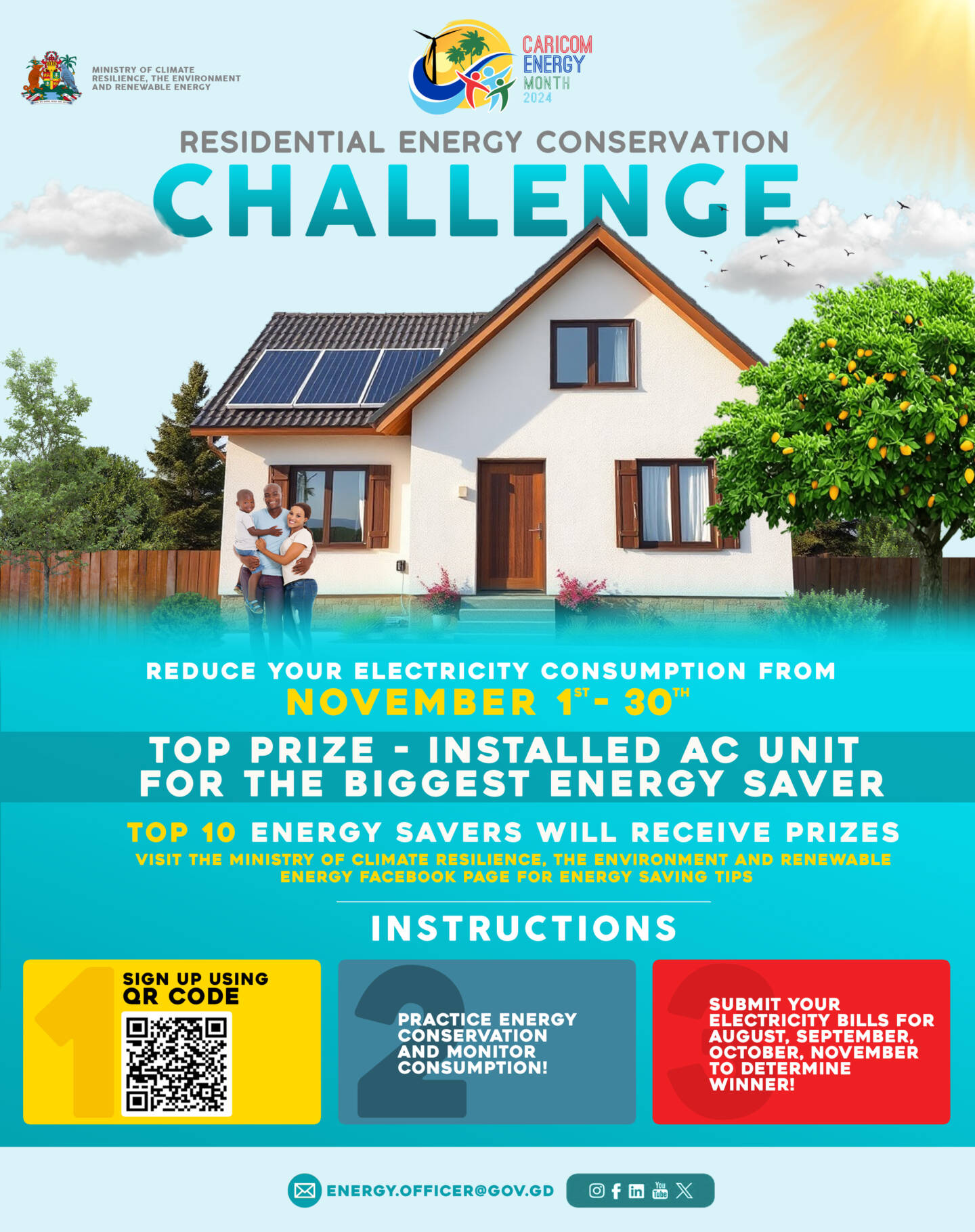











The Ministry of Climate Resilience, Environment, and Renewable Energy is excited to launch the Residential Energy Conservation Challenge (RECC), an innovative programme designed to inspire homeowners across the nation to embrace energy-saving habits and contribute to a more sustainable future.
Through this challenge, residents are encouraged to reduce their electricity consumption, supporting broader efforts in energy efficiency and the national transition to renewable energy sources.
Challenge Goals and Participation
The RECC aims to foster a culture of energy conservation by motivating residents to lower their electricity consumption based on a comparison with their previous month’s usage. By joining the challenge, homeowners can enjoy savings on their electricity bills while promoting sustainable practices within their communities.
The RECC is open to all homeowners and residents interested in joining this impactful initiative.
How the challenge works
Participants will be evaluated based on the percentage reduction in their electricity consumption over the challenge period. Key steps include:
- Sign Up: Interested homeowners can register through the following registration link.
- Energy Conservation: Participants will practice energy-saving techniques, with the option to employ energy-efficient and renewable technologies and monitor their energy use throughout the period
- Usage Comparison: At the end of the challenge, each participant’s energy reduction will be calculated by comparing their electricity bill to their consumption during the challenge period. Electricity bills (August-November) must be submitted via email to [email protected]
- Awards: The top 10 participants who demonstrate the highest reductions and commitment to conservation will receive prizes. The homeowner with the largest reduction in energy usage will be awarded the grand prize.
Why participate?
Participating in the RECC is not only a chance to reduce energy bills but also an opportunity to play a meaningful role in advancing national sustainability goals. By joining the challenge, residents are empowered to contribute to a greener future and support collective action toward energy resilience.
Registration Information: For more information and to register, please visit registration link or use the QR code provided.

Let’s power down to a brighter, greener future!
Ministry of Climate Resilience, the Environment and Renewable Energy






Renewable energy is good but not as a means of transitioning from fossil fuel to renewable energy which is the world leaders end goal. And we can’t save the earth. Man’s ideas though are going to cause distruction. The Green movement should be inline with fossil fuel use, not to eradicate it.
obviously it is beneficial to save money by being careful with energy consumption, be it Electricity, Gas, Petrol or Diesel.
However MANY scientist who are not tied to grants issued to their Universities and do not have to bow to the consensus, which is the way science is supposed to work. Point out even using data from the same agencies that say we are all going to burn, actually the data says nothing of the sort.
The hand wringing is being done by Politicians who are being fed bogus facts originating from plans drawn up by the Club of Rome after WW2, and the what is now the WEF.
CO2 is such a miniscule affecter of climate, even if it was doubled or tripled it would barely move the thermometer. Water vapour has a much greater affect.
CO2 is actually the gas of life for plants which is why even the slight increase we have had in the past decades has caused the regreening of some desert areas.
The World temperature was much hotter back in recent history. Does the dust bowl in America in the 30’s ring a bell?
It was also hotter a thousand years ago when the Romans used to grow wine in Northern England. (try that now).
It was also considerably hotter back when the Dinosaurs roamed the land.
We are actually going into a cold spell, which started back in 2020, and will continue until 2053. This is due to a Solar Minimum, where the internal cycles of the Sun cause it to give off less heat.
So while those of us near the Equator will not notice too much difference those in the Norther Hemisphere will experience progressively harder winters, and shorter Summers.
We may actually, along with our Northern neighbours experience worse weather, as it is the differential between the cold of the Poles, and the heat of the tropics that creates “weather”.