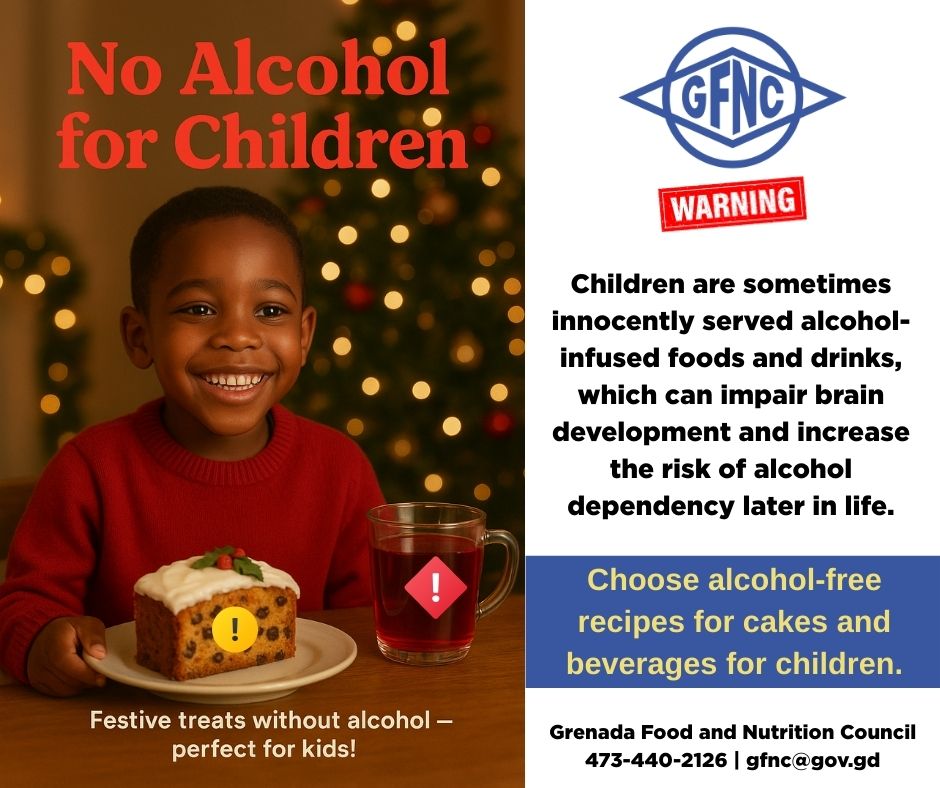










Black cake and sorrel are among the top Christmas must-haves in Grenadian households.
Tradition and cultural norms often dictate that alcohol be added to these treats. As a result, foods like these, along with beverages containing 3–4% alcohol, are sometimes innocently given to children. However, the Grenada Food and Nutrition Council (GFNC) cautions parents and guardians against allowing children and youths to consume such items, as this increases their risk of developing dependency and other health issues.
A journal article titled Too Young to Pour: The Global Crisis of Underage Alcohol Use states that “parental modelling and permissive attitudes,” along with “peer pressure and media exposure,” contribute to the normalisation of alcohol consumption. This raises an important question: how much of what children learn about drinking comes from the behaviours and messages they observe in their immediate environment? Research and statistics strongly suggest that children learn a great deal from what they observe. This reality challenges us to reflect on the role of family and society in shaping habits that can have lifelong consequences.
Another example comes from a poster produced by The University of the West Indies, St Augustine Campus’ Department of Paraclinical Sciences, Faculty of Medical Sciences, which highlights that over the past 40 years, alcohol consumption has remained consistently high. In fact, when comparing decades, usage jumped from 74.4% to 94%. Furthermore, agencies such as the Central Intelligence Agency (CIA) report that Grenada’s per capita alcohol consumption for individuals aged 15 and older was an estimated 8.62 litres of pure alcohol in 2019. Data Commons ranks Grenada as the fifth-highest consumer of pure alcohol in the Caribbean. Even the World Health Organisation (WHO) fact sheet on Grenada suggests that of particular concern is the large amount of alcohol consumed in one sitting. Specifically, 32.6% of males and females and 7.1% (15–19) drink heavily at least once in 30 days.
Parents and guardians are reminded that the Government of Grenada’s Drug Control Secretariat prohibits the “possession, use, sale, and distribution of alcohol and alcoholic beverages” around “schools, organisations, groups, and persons affiliated to the schools, at school functions.” Therefore, alcohol-infused foods and beverages should not be permitted in children’s homes either. GFNC warns that early alcohol exposure can have lifetime implications, such as the following:
- higher risk of alcohol dependence later in life
- impaired brain development
- higher involvement in road accidents
- increased likelihood of risk-taking behaviour
A solution would be to only serve zero alcohol to minors and youth. Prepare alcohol free Christmas cake and sorrel as examples. Children’s minds and bodies are still growing, so it is important to provide high-nutrient, rich foods to facilitate their healthy development. Hence, GFNC asks the public to consider this important advice.
To learn more about the GFNC visit https://gfnc.gov.gd/about-us/ and follow us on social media, https://linktr.ee/473GFNC. To schedule a nutrition counselling session, call 473-440-2126 or send an email to [email protected]. Eat Local: Strengthen Food and Nutrition Security in Grenada.
GFNC